The Payment Times Reporting (PTR) Scheme came into effect on 1 January 2021 requiring certain entities to report their payment terms to small business suppliers every six months. The information will be made publicly available through the Payments Times Reporting Register that will be maintained by the Regulator (a newly appointed Public Service position).
The aim of the scheme is to improve payment outcomes for small business by creating transparency around the payment practices of large business entities and groups. By having access to this information, small businesses can be more discerning as to who they choose to trade with. The intention is to also create cultural pressure for change to improve payment times overall.
The recommended payment term is 30 days, however, research suggests that more than a third of small business invoices are paid after that 30 day period. Normalising a 30 day payment time from large business to small business is estimated to have a net benefit of $313 million per year to the Australian economy.
The PTR obligations applies to:
The reporting requirement applies to constitutionally covered entities (CCE) that carry on an enterprise in Australia and have a total income which exceeds the following thresholds.
- Large businesses and certain government enterprises with a total annual income of over $100 million;
- Controlling corporations where the combined total annual income for all members is more than $100 million; and
- Businesses with annual income greater than $10 million if they are part of a group headed by a controlling corporation with collective income greater than $100 million.
CCE’s could include private/public companies, trusts, partnerships, joint ventures, sole traders, etc. Not for Profits have been exempted, however entities below the threshold can still voluntarily agree to report. The Regulator will have access to ATO information on turnover to determine who should be complying and penalties will apply to those who don’t.
It may be possible that there are multiple entities in a larger corporate group that have the obligation to report. Importantly, the reporting obligations are imposed on each reporting entity – a single group PTR report is not permitted.
What do you need to do?
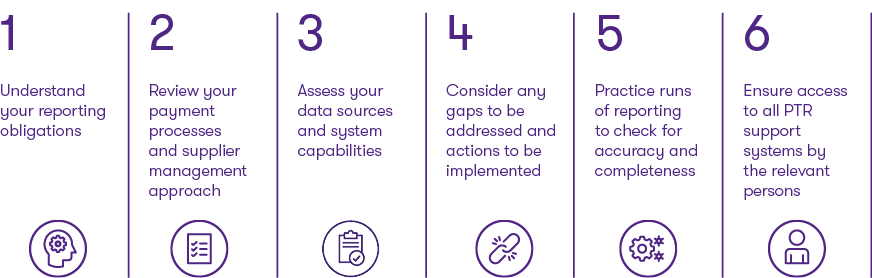
In line with the new obligations under PTR, please see the steps to take to adhere with reporting requirements:
![GTAL_2021_PaymentTimesReporting_List.png]()
Reporting entities must lodge a Payment Times report within 3 months of the end of each 6-month reporting period (2 reports for each income year).
Generally this will require the reports to be lodged by 30 September, but if you have any earlier year end e.g. 31 March, then reports will be due by 30 June.
What am I reporting on?
A PTR Small Business Identification Tool has been introduced to assist reporting entities to identify who is a ‘small business supplier’ and the legislation defines a small business as one described as such by the identification tool. Generally, this will include those entities with an annual turnover of less than $10 million for the most recent income year.
Reporting entities will need to provide details of:
- The standard payment period
- Small business invoices paid
- Small business procurement
- Use of supply chain finance
- Small business invoices
- Small business practices or arrangements
Reporting entities will be given a 12-month penalty free transition from the implementation date of the PTR to enable them to familiarise themselves with the scheme and transition effectively.
Once this period ends, failure for large entities to report could result in daily penalties of 60 penalty points ($13,320) for an individual and 300 penalty units for a body corporate ($66,600) per a day.
Does this change the need for similar reporting at a State level?
No. While there appears to be crossover with the ABCC Security of Payments reporting requirements and the various State legislation that requires (Head) Contractors in the construction industry to report around payment times, PTR is a broader reporting scheme applying to payments all Small Business suppliers, not just subcontractors. As such, you will still need to report to the PTR Regulator if you are an eligible entity and there is unlikely to be any time saved from the existing reporting.
How can we support?
To make your transition hassle-free, we can tailor our support to suit your needs; ranging from:
- Setting up a framework and processes
- Assessment of systems for suitability and data points available
- Assessment of readiness for compliance with PTR
- Building team capacity to comply with obligations, including training
- Testing of reporting outputs for completeness and accuracy
- Ongoing reporting obligation support including lodgement of reporting