





Data is at the centre of financial reporting and the auditing process. It can tell you a lot, objectively, about your business – and helps you to build a picture of a moment in time, spot unexpected outliers and exposure points, as well as trends for future strategy development.
But it is often an untapped resource for your business, not captured completely and efficiently or harnessed to its fullest capacity to give you actionable insights.
Technology and new software is transforming the audit process: safeguarding and promoting transparency; enhancing accuracy and precision; and meaningfully impacting your decision-making process.
It’s a balance between accessing the right data analytics tools and technology for your needs and objectives, with an audit team skilled in asking the right questions and identifying what this data can tell you.
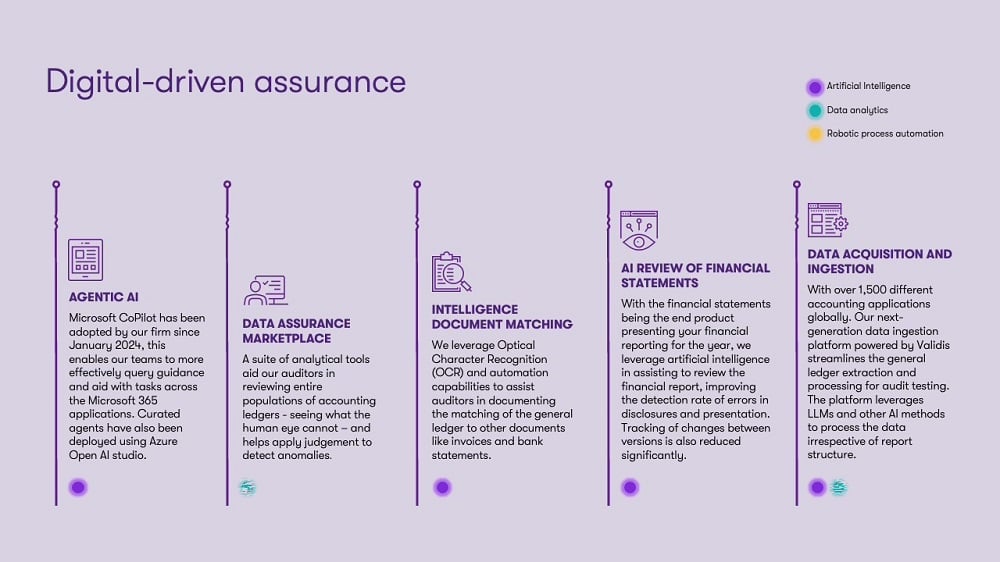
Digital-driven assurance
We embed advanced technology and innovative processes into our audits, allowing us to deliver high quality and value-enhancing insights while also reducing the burden on you. By combining predictive modeling, our advanced ledger analytics technology and artificial intelligence, our audits are known for:
Quality: When we use our technology to test full populations of data rather than using sampling, we bring more value to the audit.
Customisation: Our technology and experience enables us to tailor your audit to your highest risks and your industry.
Efficiency: We streamline our audit process through innovation, reducing the time and resources you spend gathering data and information.
Insights: Combining technology with our deep market and industry knowledge, we arm you with advice and analysis that matters most to your business and other stakeholders.
A case by case approach
We draw from a range of innovative data analytics and automation tools, and build a personalised approach suited to your specific audit circumstances, and objectives.
Our core audit technology offering is embedded into our audit process providing a modern, and standardised approach. Our technology levearages capabilities including:
- Streamlining project management with a singular collaboration portal, providing a secure and seamless method of communication between you and our auditors or other experts. You can also keep up to date on the progress of your audit.
- Modernised data analytics - incorporating your data across the audit process and with other service lines to uncover personalied insights and add value to your business.
- Embracing AI - we adopted AI to augment the review of auditors documentation, including use of textual and other document analysis - creating a customised audit for your buisness, industry and wider operations. Generative AI has been adopted to distill the collective knowledge contained in your vast quantities of underlying data.
Bringing your data to life
How people – and business leaders – consume insights is very individual. When the insights gained from data are not clearly articulated, it can be meaningless.
Advanced analytical techniques such as machine learning are the frontier of audit innovation in relation to adopting artificial intelligence. Investigating for relationships or patterns can be harnessed from the analyses of large data sets from the general ledger through to more unstructured data like contracts, invoices, banking data.
Emerging technologies together with our experienced auditors provides for an enhanced audit process, increasing our speed and accruacy in audit procedures whilst covering a larger extent of information than with manual efforts.

Services and capabilities
Audit Data analytics
Enhanced decision-making in audits using high-quality data analytics. Reduced audit sampling, favoring whole population testing. Increased insights and value-add in audits.
Algorithm and model assurance
Evaluation of accounting data models and complex calculations in financial or management reporting. Our team evaluates or replicates your calculations to ensure they’re fit for purpose.
Process and technology analysis
Mapping data flows and business processes. Gaining insights into business functions and improvement opportunities. Supporting evaluation of data governance and quality frameworks.
