For years commencing on or after 1 July 2023, Australian public companies that prepare financial statements under Chapter 2M of the Corporations Act 2001 are required to provide a consolidated entity disclosure statement (‘CEDS’).
Entities that are required to consolidate subsidiaries must provide summary information regarding the entities comprising their consolidated group. Entities that are not required to prepare consolidated financial statements will be required to make a statement to this effect. Directors will also be required to include a statement within their directors’ declaration that CEDS is ‘true and correct.’
Download the full Consolidated Entity Disclosure Statement and FAQ's
The Treasury Laws Amendment (Making Multinationals Pay Their Fair Share – Integrity and Transparency) Bill 2023 (‘the Amendment’) was passed on the 27 March 2024 by the Federal Government. The Amendment modifies the Corporations Act 2001 (‘the Act’) such that Australian public companies are required to disclose specific information about their subsidiaries within their annual financial reports in the form of a ‘consolidated entity disclosure statement’ (‘CEDS’ or ‘the Statement’). The CEDS is a separate statement included in the annual financial report.
The Amendment applies for the first time for financial years ending on or after 30 June 2024. Management of public companies that report under the Act should consider the information required to be disclosed within the CEDS by the Amendment and commence a project to gather the required data, including implementing appropriate control structures. The information required includes the legal name of each entity within the consolidated group, its place of incorporation, and its tax residency, without the context of materiality.
The stated purpose of the Amendment is to protect the integrity of the Australian tax regime and improve transparency regarding taxation outcomes. The Amendment also included changes to the thin capitalisation regime for foreign-controlled entities or outbound multinational groups.
Which entities are impacted by the Amendment?
The Amendment applies to all public companies reporting under the Act, including unlisted public companies. The Amendment applies regardless of whether they prepare consolidated financial statements, but with varying impact.
It does not apply to proprietary companies, trusts, registered schemes, registrable superannuation entities or public companies that do not report under the Act (e.g. those that report under the Australian Charities and Not-for-profits Commission Act 2012).
What is the impact on these entities?
All public companies reporting under the Act are required to prepare a CEDS, regardless of whether they are required to prepare consolidated financial statements or not. If the entity is not required to provide the summary information required by the Amendment, they are required to make a statement to that effect within the CEDS.
What is the CEDS?
The CEDS is a separate statement and a component of the annual financial report. The Amendment changes the required contents of an annual financial report defined in section 295 of the Act to constitute:
a. The financial statements for the year; and b. The notes to the financial statements; and c. For a public company—the consolidated entity disclosure statement; and d. The directors’ declaration about the statements and notes.
What information is the CEDS required to contain?
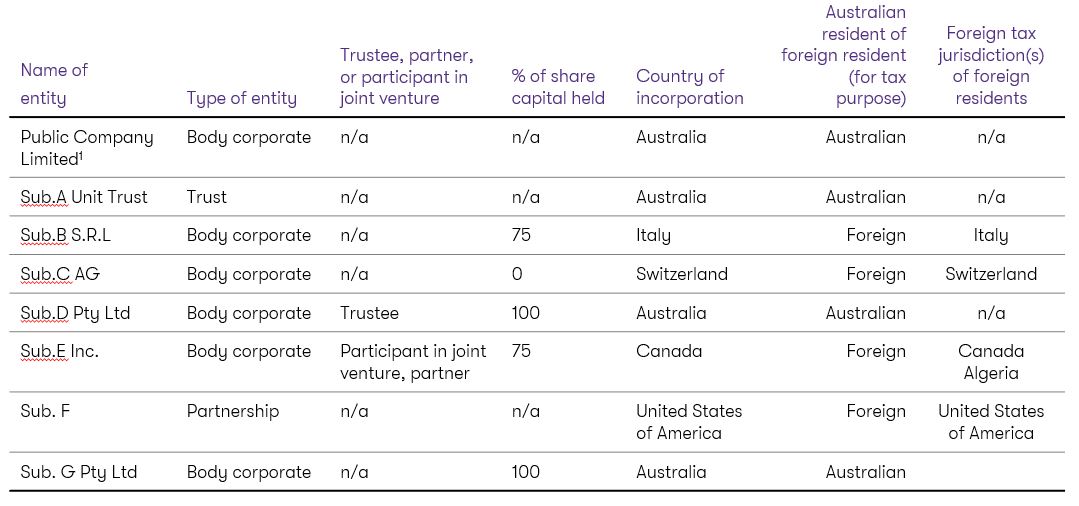
The Amendment adds s295(3A) to the Act and requires the following information to be included in the CEDS for each entity within the consolidated group (including the parent):
The entity’s name
Whether:
The entity was a body corporate, partnership, or trust; and
The entity was a trustee of a trust, partner in a partnership, or participant in a joint venture where the trust, partnership and joint venture are consolidated.
If the entity is a body corporate:
The place of incorporation; and
The percentage of the entity’s issued share capital that was held by the public company at the end of the financial year.
Whether, at the end of the financial year:
The entity was an Australian or foreign tax resident; and
If the entity was a foreign resident, a list of each foreign jurisdiction in which the entity was a tax resident.
Where the entity is not required to provide this information as it is not required to prepare consolidated financial statements, it must make a statement to this effect within the CEDS. Such an entity is not required to provide the information above.
Is there an impact on other parts of the annual financial report?
Directors are required to confirm in their directors’ declaration that the information disclosed in the CEDS is ‘true and correct’.
‘True and correct’ is different to the ‘true and fair’ declaration that applies to other parts of the financial report and is not defined in the Amendment or elsewhere in the Act. The intent of the statement, as described in the explanatory memorandum issued in support of the Amendment, is to ensure that the disclosures in the CEDS are complete and accurate.
Is there an impact on reporting by CEOs and CFOs for public companies that are listed?
CEOs and CFOs of listed public companies are required to include the same statement in their section 295A declaration to directors.
What is the consequential impact of the statement of ‘true and correct’ on directors?
By making a statement that the CEDS is ‘true and correct’, directors appear to be being held to a higher threshold of accuracy than ‘true and fair’. As a result, appropriate control structures will need to be established by companies as part of their annual financial reporting process to provide directors with the necessary information to allow them to make the statement of ‘true and correct’.
This may require entities to undertake a project to collate the appropriate data, engage with international taxation experts, and accelerate taxation processes to ensure that matters such as tax residency are appropriately disclosed in accordance with relevant tax legislation.
What is the consequential impact on the audit opinion?
As the CEDS is a part of the annual financial report, the auditor is required to report whether ‘reasonable assurance’ that the following items are not materially misstated has been obtained:
the CEDS; and
the opinion of the directors in the directors’ declaration that the CEDS is true and correct.
Frequently Asked Questions
Yes, the entity is required to prepare a CEDS. The entity is required to make a statement the entity is not required to prepare consolidated financial statements. For clarity to users, we recommend a statement as to the reason why a CEDS is not included.
No. ASIC has made an explicit statement that the CEDS must be a separate statement and cannot be included as a note to the financial statements, or as an addition to other information within the financial statements.
No. Investment entities, defined in AASB 10 Consolidated Financial Statements, are required to consolidate only those subsidiaries whose main purpose and activities are providing services that relate to the investment entity’s investment activities. The Amendment is explicit in that it applies to entities that are ‘part of the consolidated entity’. As a result, in our opinion, the CEDS would only include those subsidiaries that are required to be consolidated and exclude those that are excluded from consolidation.
The CEDS is not scope limited to only those entities that are ‘direct’ subsidiaries – i.e. only those entities which the public company has a direct ownership interest (vs indirect through other subsidiaries). All entities required to be included in the consolidated financial statements of the group of which the public company is the parent are required to be included.
Yes. ASIC has made an explicit statement requiring all consolidated subsidiaries be included, regardless of materiality.
The CEDS will form part of the annual financial report and, as a result, will be subject to audit procedures. This will impact the scope of engagements with auditors.
‘True and correct’ is not defined within the Act. The explanatory memorandum for the Amendment described it as being similar to ‘complete and accurate’.
The auditor will opine separately on the CEDS. This opinion may be ‘clean’ – i.e. unmodified – or it may be modified. As of the date of this document, entities should not assume that unmodified opinions will be achievable in the context of the definition of ‘true and correct’ and the requirement that all subsidiaries, regardless of materiality, be included. Guidance is being sought from the Auditing and Assurance Standards Board.
The Amendment and its explanatory memorandum does not include a definition or explanation of ‘part of the consolidated entity’. In our view, an entity that is not a subsidiary of a public company is not a ‘part of’ the public company, but instead represents an asset held by the public company. The definition of a subsidiary is contained within AASB 10 Consolidated Financial Statements. This definition can be nuanced and is not limited to legal ownership of share capital or its equivalent. We recommend directors consider engaging financial reporting specialists to assist in assessing control where more complex arrangements exist as a part of the implementation of appropriate controls.
Determination of tax residency is complex, a matter of law, and may be required to be determined on an operation-by-operation basis (and not entity-by-entity). As a result, we recommend that entities consider obtaining formal advice from tax experts. ASIC has stated that ‘entities that determine tax residency in good faith and in accordance with the Commission of Taxation’s public guidance may declare that the tax residency status of a subsidiary is true and correct for the purpose of the CEDS.’
Yes. All subsidiaries are required to be included. That the subsidiary is not a tax resident of any jurisdiction is required to be disclosed.
The definition of a ‘body corporate’ in this context is not clearly defined within the Act. The Department of Finance has published a definition as follows:
A legal entity, other than a body politic or a natural person. It includes a statutory corporation, a company and an incorporated association.
The intent of this definition, and its usage in the Amendment, would indicate that all subsidiaries of the public company are required to be included, regardless of their legal structure.
No. The CEDS is prepared only as a part of annual financial reports.
No. The CEDS is prepared with respect to the current financial reporting date only.
This statement is required to be included in a CEDS, not as a part of the directors’ report, directors’ declaration, or annual financial statements. Many entities will include a CEDS that is limited to this statement.
We recommend that directors include a basis of preparation explaining the accounting and taxation judgements made by directors in preparing the CEDS.
An example has been included in the Appendix to this document.
Consolidated Entity Disclosure Statement – entity is not required to prepare consolidated financial statements
Where a public company does not have any subsidiaries
Public Company Limited does not have any controlled entities and therefore is not required by the Australian Accounting Standards to prepare consolidated financial statements. As a result, Public Company Limited has not prepared a consolidated entity disclosure statement.
Where a public company is not required to prepare consolidated financial statements because it is an investment entity
Public Company Limited is an investment entity applying the exemption from consolidation described in AASB 10 Consolidated Financial Statements and does not have any subsidiaries that are not investments. The entity is not required by Australian Accounting Standards to prepare consolidated financial statements. As a result, Public Company Limited has not prepared a consolidated entity disclosure statement.
Directors report – where a public company is not required to prepare consolidated financial statements because it is an intermediate parent and the exemptions within AASB 10 are applied
Public Company Limited is an intermediate parent applying the exemption from consolidation described in paragraph 4 of AASB 10 Consolidated Financial Statements. The entity is not required by Australian Accounting Standards to prepare consolidated financial statements. As a result, Public Company Limited has not prepared a consolidated entity disclosure statement.
Consolidated Entity Disclosure Statement – Basis of preparation
Basis of Preparation
This Consolidated Entity Disclosure Statement (CEDS) has been prepared in accordance with the Corporations Act 2001 and includes required information for each entity that was part of the consolidated entity as at the end of the financial year.
Consolidated entity
This CEDS includes only those entities consolidated as at the end of the financial year in accordance with AASB 10 Consolidated Financial Statements (AASB 10).
Determination of Tax Residency
Section 295 (3A) of the Corporations Act 2001 defines tax residency as having the meaning in the Income Tax Assessment Act 1997. The determination of tax residency involves judgment as there are currently several different interpretations that could be adopted, and which could give rise to a different conclusion on residency.
In determining tax residency, the consolidated entity has applied the following interpretations:
Australian tax residency
The consolidated entity has applied current legislation and judicial precedent, including having regard to the Tax Commissioner's public guidance.
Foreign tax residency
Where necessary, the consolidated entity has used independent tax advisers in foreign jurisdictions to assist in its determination of tax residency to ensure applicable foreign tax legislation has been complied with.
Partnerships and Trusts
Australian tax law does not contain specific residency tests for partnerships and trusts. Generally, these entities are taxed on a flow-through basis so there is no need for a general residence test. There are some provisions which treat trusts as residents for certain purposes but this does not mean the trust itself is an entity that is subject to tax.
Additional disclosures on the tax status of partnerships and trusts have been provided where relevant.
Please note the information and attachments on this page are subject to change without notice. Last edited 16 July 2024.
There is positive news for individuals looking to grow their superannuation balance. In addition to the general transfer balance cap increasing from $2m to $2.1m, the concessional and non-concessional contribution caps are also set to increase from 1 July 2026.
In today’s rapidly evolving business landscape, sustainable innovation is a strategic imperative. For mid-sized businesses, embedding sustainability into operations not only meets growing stakeholder expectations, but also unlocks new avenues for growth, efficiency, and resilience.
Boards play a critical role in the success of private businesses by providing strategic direction, advising the Executive team, overseeing business performance, and managing risk and compliance. To fulfill these roles effectively, Board members need to be equipped with insightful information.
Subscribe now to be kept up-to-date with timely and relevant insights, unique to the nature of your business, your areas of interest and the industry in which you operate.