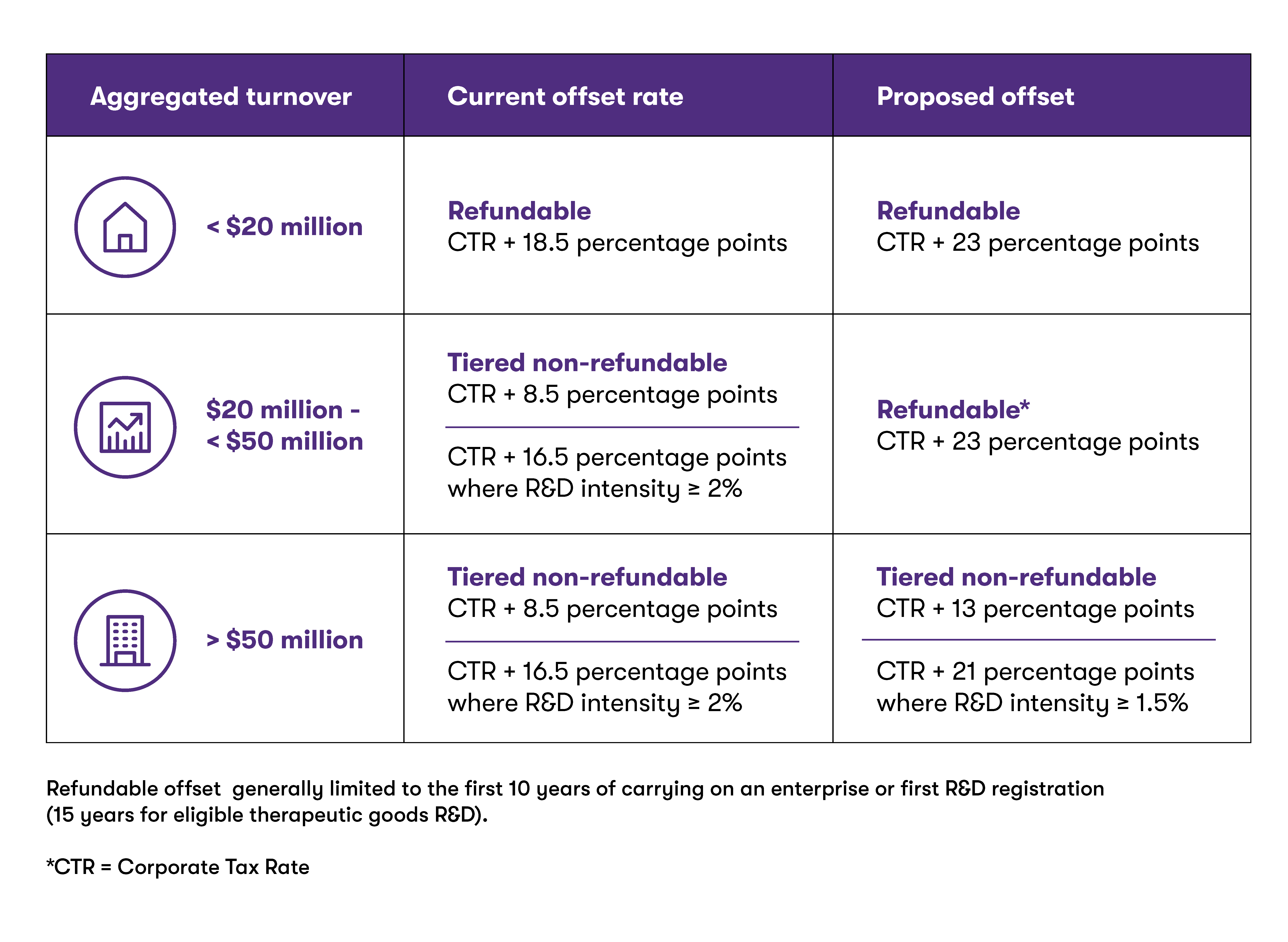
Treasury has released draft legislation proposing major changes to the R&D Tax Incentive, including higher offset rates, expanded refundable eligibility thresholds and revised expenditure caps, with consultation open until 28 September 2026.
The most significant proposed change is the removal of supporting R&D activities from eligibility, which could materially affect the value of claims for businesses that currently rely on these activities.
New refundability rules would generally limit access to refundable offsets to the first 10 years of carrying on an enterprise, while providing an extended 15-year period for eligible therapeutic goods R&D activities.
The Federal Government announced significant proposed reforms to the Research and Development Tax Incentive (RDTI) as part of the 2026-27 Federal Budget.
The next phase of R&D Tax Incentive reform
On 11 September 2026, Treasury released exposure draft legislation and explanatory materials outlining how the reforms would operate in practice. The draft legislation is now open for consultation until 28 September 2026.
The reforms form part of the Government's response to the Ambitious Australia: Strategic Examination of Research and Development review and are aimed at better incentivising R&D that leads to positive economic spillovers while moderating the fiscal cost of the program.
The proposed changes are not yet law and are intended to apply to income years commencing on or after 1 July 2028. However, businesses should begin assessing the potential impact on future R&D claims.
The proposed reforms at a glance
1. Enhanced incentive rates
Refundable turnover threshold increases from $20m to $50m.
Maximum eligible expenditure increases from $150m to $200m.
Intensity threshold to access higher non-refundable rates reduces from 2.0 per cent to 1.5 per cent.
2. Narrower eligibility for R&D activities
Supporting R&D activities would no longer qualify for the RDTI.
3. New refundability rules
Refundable offsets will be generally limited to the first 10 years the company carries on an enterprise.
R&D conducted to develop a therapeutic good will allow access to a 15-year refundable period.
Companies conducting R&D outside these periods may still access a non-refundable offset.
What is staying the same?
The draft legislation does not propose changes to:
the core experimental activities framework
self-assessment, documentation and registration requirements, or
the co-administration model between DISR and the ATO.
A closer look at the proposed reforms
The most significant change to the scope of the RDTI is the proposed removal of supporting R&D activities. Under the current rules, an activity may be eligible as a supporting R&D activity where it is directly related to a core R&D activity or, for certain excluded activities, undertaken for the dominant purpose of supporting a core R&D activity.
The exposure draft would repeal the supporting R&D activity provisions. This means expenditure previously claimed for typical supporting activities such as background research and investigations, data collection, project management or other activities connected with the experimental work may not be eligible. In addition, expenditure on excluded core activities, which previously could be claimed as a dominant purpose supporting activity, may also be unable to be claimed.
Whether an activity remains eligible will depend on whether the activity itself satisfies the legislative requirements for a core R&D activity. The draft does not introduce a new substantive test for the remaining activities. Instead, the existing core R&D activity requirements in section 355-25 of the Income Tax Assessment Act 1997 would continue under a renamed “R&D activities” concept.
While the policy intent is clear that ‘supporting activities’ will no longer be able to be claimed, further guidance will likely be required on how the distinction between eligible R&D activities and ineligible supporting activities will operate in practice.
The draft legislation proposes increasing all R&D tax offset premiums by 4.5 percentage points. This would increase the benefit obtained in relation to eligible R&D expenditure that remains able to be claimed under the revised rules.
The aggregated turnover threshold for the refundable R&D tax offset is proposed to increase from $20m to $50m. This may allow a broader group of growing and mid-market businesses to access a cash refund, or a higher non-refundable offset.
Under the exposure draft, an entity with aggregated turnover below $50m would generally be eligible for the refundable offset only where a day in the relevant income year occurs before the tenth anniversary of the earlier of:
the day the entity first started carrying on an enterprise, or
the day the entity was first registered for R&D activities.
The draft extends this test to connected and affiliated entities and further guidance may be needed on the practical application of this test to complex group structures and changes in ownership.
An R&D entity outside the 10-year refundable period that has aggregated turnover below $50m would remain eligible for a non-refundable offset at the higher premium rate of 23 percentage points above its corporate tax rate.
The cash-flow impact of this change could be material for mature, innovative companies who regularly generate tax losses. A non-refundable offset can reduce tax payable and can be carried forward, but it does not provide the same immediate cash benefit as a refundable offset.
Companies conducting R&D activities for the dominant purpose of generating new knowledge about therapeutic goods, or their therapeutic use, may be able to access the refundable offset for up to 15 years. This carve out for biotechnology and medical technology R&D recognises the longer development timelines often associated with these R&D projects.
Consultation is also being sought on whether clinical manufacturing research and development expenditure should also be eligible for the RDTI.
The minimum expenditure threshold would increase from $20,000 to $50,000, while the maximum expenditure threshold would increase from $150m to $200m, providing additional support to the RDTI’s largest claimants.
What does this mean for businesses?
While the proposed reforms increase the value of the incentive for many businesses, they also narrow the scope for activities that may qualify. Whether a company is better or worse off will depend on its R&D profile, expenditure mix and entitlement to refundability.
For example:
Early-stage businesses may benefit from the increase in the refundable offset turnover threshold from $20 million to $50 million.
Large R&D claimants may benefit from the increased benefit rates, reduced intensity thresholds and a higher expenditure cap.
Businesses that currently claim significant supporting R&D expenditure may see a reduction in their claim size.
Companies outside the proposed 10-year refundable period may no longer receive an immediate cash refund and may need to consider the resulting cash-flow and funding implications.
How businesses can prepare
The proposed changes to the RDTI are not yet law and are intended to apply to income years commencing on or after 1 July 2028. However, businesses should consider the potential impacts and prepare by:
Reviewing the proportion of their current claim that relates to supporting R&D activities
Assessing whether they may be affected by the proposed 10-year refundable offset limitation
Understanding the potential impact on future R&D cash flow
Monitoring further developments as the consultation process progresses and draft legislation is refined
Our view
The proposed reforms represent the most significant redesign of the R&DTI since the program’s inception. The Government's policy intention is clear: increase the value of support available for experimental R&D activities while improving the fiscal sustainability of the program and focusing benefits on younger, innovative businesses.
For many businesses, a key consideration will be the proposed removal of supporting R&D activities. While the higher offset rates are positive, the practical impact will depend on how much of a company's current claim is attributable to activities that continue to qualify under the program, and whether some activities currently claimed as supporting R&D activities may instead form part of an eligible R&D activity under the new proposed rules. There is potential for some of the activities that are currently claimed as supporting R&D activities to continue to qualify in practice, reducing the impact of the change.
From an administrative perspective, the reforms may also simplify claim preparation by reducing the number of activities required to be included in R&D applications and limiting the need to allocate expenditure across multiple activity categories.
The consultation process will be particularly important in assisting industry and government to understand the practical implications of these changes, especially in relation to activity classification, cost allocation and the operation of the proposed 10-year refundability rules for entities with complex structures.
While the increased offset rates and broader turnover threshold will be welcomed by many businesses, the proposed removal of supporting R&D activities has the potential to significantly change the way R&D claims are prepared and documented. As the consultation process progresses, the practical application of these rules may prove just as important as the legislative changes themselves.
We're here to help
The proposed RDTI reforms may have different impacts depending on your business, industry and R&D activities. While the changes are not yet law, now is a good time to understand how your future claims could be affected.
Our Innovation Incentives team can assist businesses to:
Assess how the proposed reforms may affect the value of current and future R&D claims
Review existing R&D activities and expenditure methodologies against the proposed removal of supporting R&D activities
Evaluate the potential impact of the proposed refundability rules, including the new 10-year and 15-year eligibility periods
Model the financial impact of the revised offset rates and expenditure thresholds
Strengthen documentation, governance and contemporaneous record-keeping processes
If you would like to discuss how the proposed reforms may affect your business, please contact a member of our Innovation Incentives team.
Article contributed to by Alana Bayliss– Innovation Incentives
Australia’s R&D policy is back in focus ahead of the Federal Budget, with the SERD review highlighting declining investment and the need for reform. While no immediate changes to the R&D Tax Incentive have been announced, businesses should watch for potential policy shifts and ensure strong governance, compliance, and documentation under the current framework.
With the 30 April 2026 registration deadline approaching, companies that performed R&D activities in the year ended 30 June 2025 should be reviewing eligibility, documentation and governance now to preserve their entitlement under the RDTI.
Subscribe now to be kept up-to-date with timely and relevant insights, unique to the nature of your business, your areas of interest and the industry in which you operate.