Earlier this year the Queensland Parliament passed legislation expanding the application of mandatory Project Bank Accounts (PBA’s) and renaming them to Project Trust Accounts (PTA’s).
With the results of the Queensland election confirming a majority Labor government for the next four years, contractors should start planning for implementation of latest round of BIFA reforms.
PBA’s were first introduced in the Building Industry Fairness (Security of Payment) Act 2017 and were intended to ensure those in the building and construction industry are paid for their work.
As noted in our previous alert, the Queensland Government sought to implement the majority of recommendations made by the special task force, who put together the Building Industry Fairness Reforms Implementation and Evaluation Panel Report following a review of the initial implementation of PBA’s.
The Building Industry Fairness (Security of Payment) and Other Legislation Amendment Bill 2020 included the following key changes to the PBA (now PTA) regime:
- replaced “Project Bank Accounts” with “Project Trust Accounts”
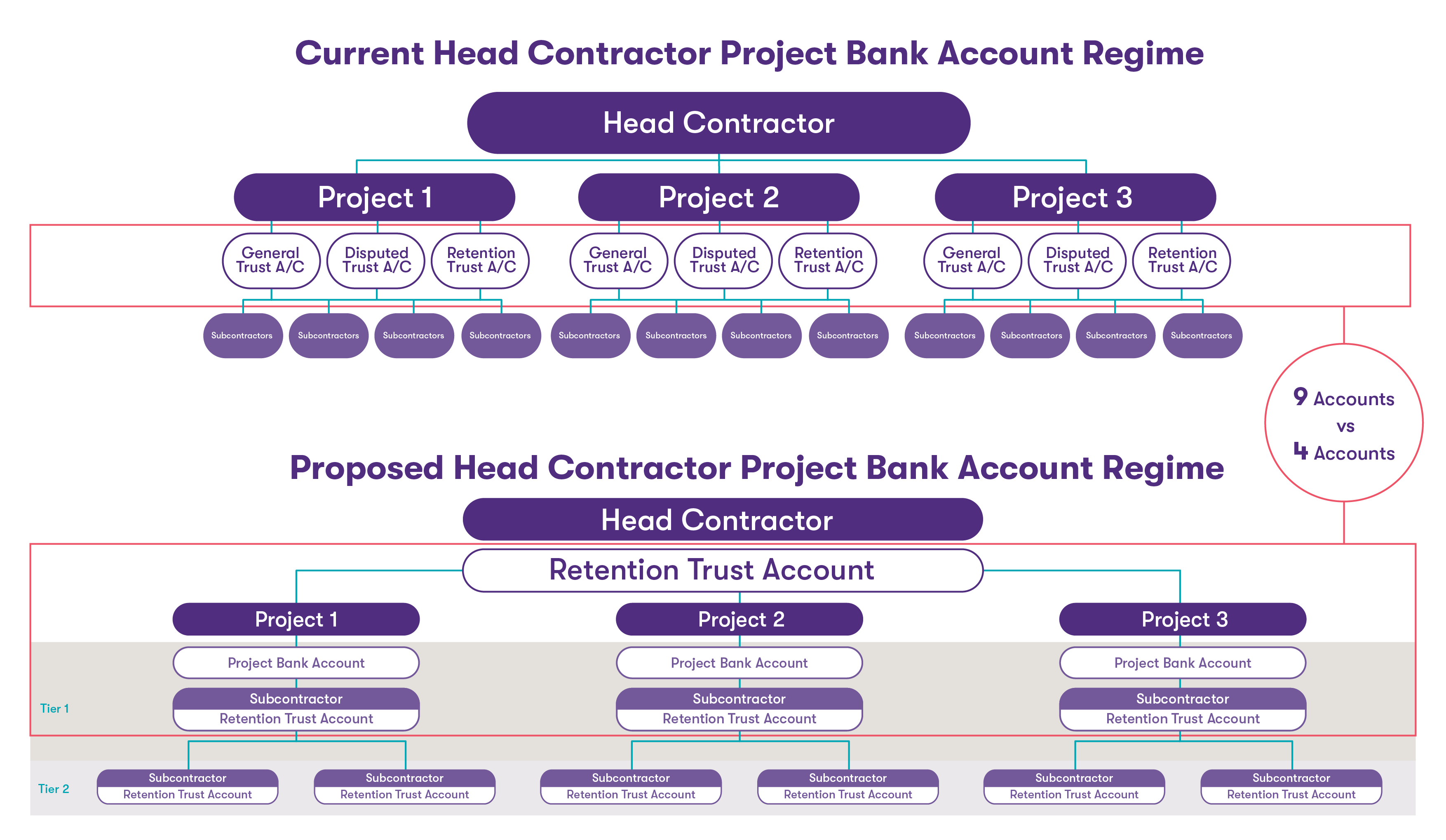
- introduce an obligation to maintain a single Retention Trust Account to manage retention monies
- remove the requirement for a disputed funds trust account
- removal of the requirement for principals to have viewing access of the trust accounts
While head-contractors may be relieved by the simplification of the regime (removal of the requirement to maintain disputed funds trust accounts and retention monies trust accounts on each and every qualifying project), subcontractors will now be burdened with the obligation to maintain a retention trust account for monies retained from downstream subcontractors. Fortunately, only a single retention trust account is required regardless of the number of projects being undertaken.
![GTAL_2020_REC_Current_PBA_Regime.png]()
Click to enlarge
The new Trust Account requirements will be phased in gradually and eligibility for each phase will be defined by who is the project owner (or principal), the contract price for the project, and whether there are subcontractors engaged as follows:
| |
New Commencement Date
|
Previously Advised
|
| New government and hospital and health service contracts > $1m |
1 July 2021 |
1 July 2020 |
| Private sector, government owned corporations & local government contracts > $10m |
1 January 2022 |
1 July 2021 |
| Private sector, government owned corporations & local government contracts $3m to $10m |
1 July 2022 |
1 Jan 2022 |
| Private sector contracts > $1m |
1 January 2023 |
1 July 2022 |
Those impacted by PTA’s will need to be aware of the changes and prepare their business for the new layer of administration required for projects, and restricted access to cash generated from projects after the relevant commencement date. Despite the simplification of the regime, head contractors will still incur a significant level of additional administration in managing the new accounts.