There is no doubt about it – Australia’s energy future will be one of increasing renewable capabilities. The last 12 months, coupled with pre-Budget announcements in what the Australian media have dubbed ‘Energy Week’, has seen a definitive shift in political discourse on Australia’s energy future.
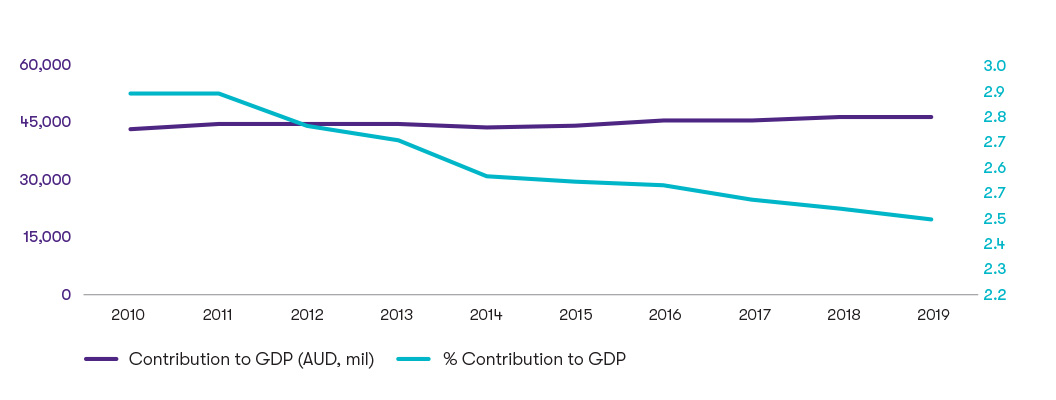
The data we have from our ‘Federal Budget: A 10 year retrospective’ tells us there has been a lack of consistency in policy and investment for the sector over the last decade. Of all the industries we feature in this report, energy has amongst the lowest investment from Government, and this has resulted in a small and steady contribution to GDP in millions, but a steadily declining contribution as a percentage of GDP (as you can see in the chart below).
This graph was likely to start trending upwards based on policy changes we’ve seen in the last 12 months. COVID, however, may accelerate the speed of the sector’s contribution to the economy over the next decade as priorities are laid out and projects come online.![GTAL_2020_Energy_FB_Graph.jpg]()
The potential for the energy sector to transform our economy is huge
The Government has already stated that reliable energy will be critical to Australia’s future economic prosperity. However, setting a national policy for Australia has been difficult in the past, with the States ultimately having control over energy production, distribution and regulation. It appears we are about to come into a potential 18 month period without a State or Federal election. This could be the window we need to get all of our ducks in a row without the usual grandstanding. The Federal Government’s $18b Technology Investment Roadmap and an additional $1.9b renewable energy package to drive efficiencies in the six priority industries is exciting progress. Now we need efficient and streamlines regulations and a consistent national framework of implementation to allow Australia to become a renewable energy leader.
In our report we cover:
- Did the lack of consensus stall investment?
- What’s preventing the shift to renewables right now?
- The road to hydrogen
- Investment in energy will help us to grow out of the recession
- So where to from here?
![GTAL_2020_Federal-Budget-2020-21.jpg]()
Looking back to look forward
We were initially writing the ‘Federal Budget: A 10 year retrospective’ report before COVID-19 as an advocacy piece for more industry investment and support. Of course, the way the year started is not the way the year is ending. Many sectors that had been left to their own devices are now key for our recovery. Sovereign capability. Jobs. Digital economy. Modern manufacturing. Renewable future. Deregulation. Innovation. These are the terms we will use as we settle into COVID-normal.
Our report looks retrospectively at 13 different industries, the investment made into them by Government and their contribution to GDP. This is then overlaid with the opportunity we see for industry in this new normal based on recent Government announcements.
Download report