Has the digital economy been left to sort itself out? Yes. It’s unquestionably a sector the Government understands the value of, but didn’t know how to treat. Technology investment has not been front of mind in the Australian public sector since 2014.
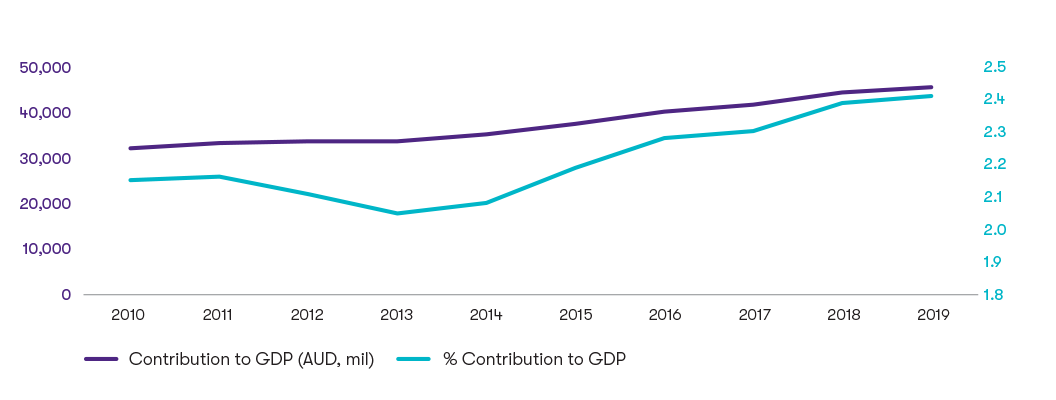
When you look at the data in our ‘Federal Budget: A 10 year retrospective’ you will see that the big Budget blip in 2012 and 2013 is basically the NBN. GDP contribution has been rising, as both a percentage and financial contribution, but Australia is not a global player and we don’t make it into the OECD’s top ten world exporters of ICT services. That top spot goes to Ireland, which has actively positioned themselves as a technology hub for Europe.
![GTAL_2020_TM_FB_Graph.png]()
How do we become a leading digital economy?
COVID has precipitated an exciting acceleration of the already fast paced tech sector. And policymakers are finally coming to grips with the potential of technology to drive growth for businesses and are taking clear steps to mitigate the risk of cybercrime with the significant $1.67b 2020 Cyber Security Strategy. This acted as a nice precursor to the $4.5b in funding for NBN upgrades to roll out fibre to Australian homes.
It’s clear we need more equitable access to early stage funding in Australia. We need to encourage investment and commercialisation in Australia – taking things to the next level without having to go offshore to do so, and this involves readily available capital, the right infrastructure to facilitate innovation and growth, and better incentives for R&D. If the Government doesn’t do anything meaningful for the technology industry then they’ve dropped the ball. In our report we cover:
- Has the digital economy been left to sort itself out?
- Access to capital is a perennial problem in growing the technology industry
- Our future is trending digital
- A digital economy comes with cybercrime
- It all starts at school
- Cooperation between State and Federal Governments will be key
- So where to from here?
![GTAL_2020_Federal-Budget-2020-21.jpg]()
Looking back to look forward
We were initially writing the ‘Federal Budget: A 10 year retrospective’ report before COVID-19 as an advocacy piece for more industry investment and support. Of course, the way the year started is not the way the year is ending. Many sectors that had been left to their own devices are now key for our recovery. Sovereign capability. Jobs. Digital economy. Modern manufacturing. Renewable future. Deregulation. Innovation. These are the terms we will use as we settle into COVID-normal.
Our report looks retrospectively at 13 different industries, the investment made into them by Government and their contribution to GDP. This is then overlaid with the opportunity we see for industry in this new normal based on recent Government announcements.
Download report