The issue is rarely a lack of commitment. More often it is incomplete asset information, inconsistent processes and limited visibility of asset performance.
As infrastructure networks age and financial pressures increase, these gaps become increasingly consequential.
Why asset management matters more than ever
Councils are under increasing pressure to balance ageing infrastructure, growing community expectations, constrained funding and ongoing workforce capability challenges.
At the same time, decisions regarding renewal, maintenance and investment are becoming more complex. Asset portfolios continue to grow, replacement costs continue to rise, and communities rightly expect transparent and evidence-based decision-making.
Effective asset management helps councils direct limited resources to the areas of greatest need, extend asset life, improve service outcomes and support long-term financial sustainability.
Asset management is not just an infrastructure issue. It is a governance and financial sustainability issue. Decisions regarding maintenance, renewal and capital investment are only as effective as the information available to those making them.
Benchmarking against ISO 55001:2024
Throughout recent independent asset management maturity assessments across metropolitan and regional NSW Local Councils, a consistent pattern emerges. In no area did every council reach the highest level of maturity – and that shouldn’t be the goal.
With finite funds stretched across a growing asset base, pursuing top-tier maturity across every requirement is neither realistic or good value. While no council is seeking perfection across every aspect of asset management, common strengths and improvement opportunities emerge consistently across the sector.
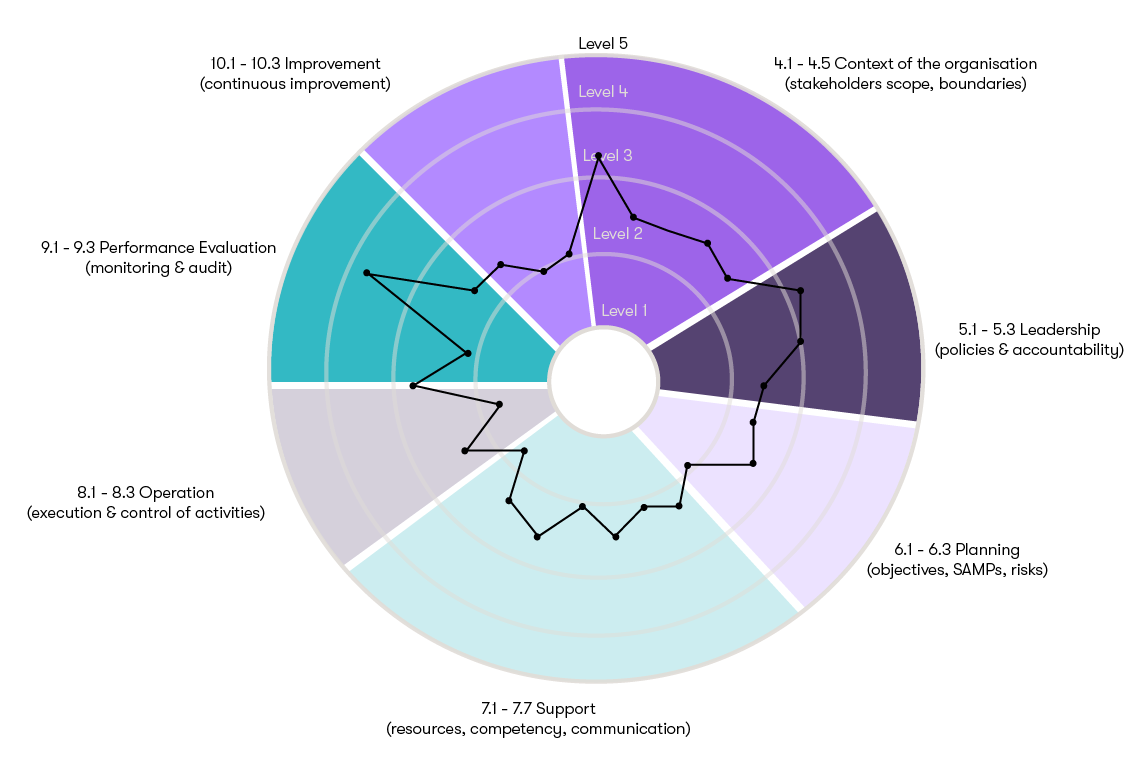
The diagram below is best read as a clockwise continuum. The early areas are foundational, enablers that everything else is built on, while those toward the end reflect the effectiveness of execution, and the final few are more advanced practices.
If read this way, a clear story emerges: councils tend to perform well in the foundational, front-end areas, but fall away as the focus shifts to execution. A common thread was incomplete and disparate asset information that limits confident, evidence-based decision-making the later requirements depend on.
![]()
Asset Management Maturity Level scale:
| 1 |
2 |
3 |
4 |
5 |
|
Aware
|
Basic
|
Core
|
Intermediate
|
Advanced
|
What councils are generally doing well
Overall, councils are generally performing well in the fundamentals:
- executive recognition of the strategic importance of asset management
- well-established policies and governance frameworks
- strong alignment with integrated planning and reporting requirements
- growing use of assurance activities, including internal audits and maturity assessments.
While the basics are largely in place, the greatest opportunities now sit in the more complex and less visible aspects of asset management.
Areas for improvement
The areas for improvement relate predominantly to data recording and execution. They point to inherent complexities in delivering asset management in a local government context.
Confidence in asset data
Many councils still face challenges with incomplete, inconsistent or outdated asset information. This makes it difficult to confidently prioritise renewal programs, forecast future investment requirements and demonstrate value for money.
Turning strategy into practice
Asset management strategies are often well developed, but operational processes are not always consistently embedded across the organisation.
Managing organisational knowledge
Reliance on key individuals remains a risk in many councils. Staff movement can result in significant loss of historical asset knowledge and established practices.
Closing the continuous improvement loop
Many councils collect large volumes of information but undertake less structured review of whether asset management activities are delivering intended outcomes.
Key takeaway
The challenge facing local government is no longer whether asset management frameworks exist, because in most cases, they do.
The next stage is improving the quality of information, strengthening operational execution and ensuring investment decisions are supported by reliable evidence.
Councils that successfully bridge this gap will be better positioned to manage ageing infrastructure, demonstrate financial sustainability and maintain community trust.
Looking ahead
The opportunity for many councils is not establishing asset management frameworks, but ensuring those frameworks drive consistent and evidence-based decision making.
Independent reviews can provide valuable insight into where processes are working well, where risks exist and where effort should be focused to achieve the greatest benefit.
Targeted improvements in data quality, governance and operational execution can significantly strengthen asset management outcomes without requiring wholesale transformation.
If you’d like to discuss asset management in your local council, please reach out to one of our experts today.
Learn more about how our Risk services can help you