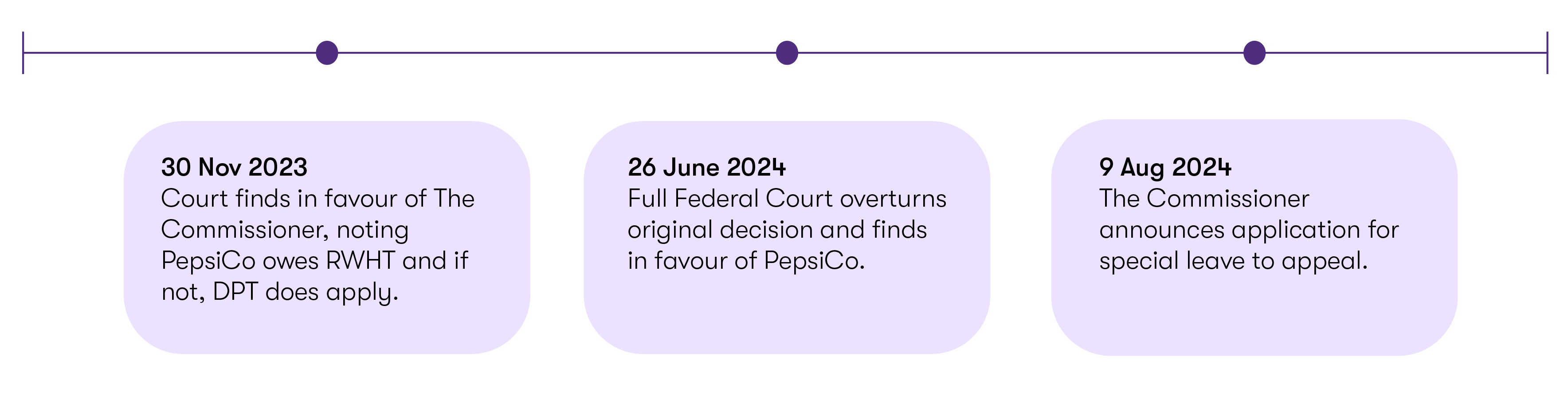
While this move was not surprising, it is significant as it evidences the ATO’s continued focus on embedded royalties, and intellectual property more generally, for tax purposes and the application of Diverted Profits Tax (DPT).
Below is a high-level timeline of the milestone dates pertinent to this case:
![A diagram displaying a timeline of case events]()
In addition, an overview of the recent June appeal outcome is outlined below.
PepsiCo wins appeal
In the verdict handed down on 26 June 2024, the Full Federal Court overturned the original decision and found there was no liability for PepsiCo to remit AUD $3.6m in royalty withholding tax to the ATO for the 2018 and 2019 years. Further, the Court dismissed the Commissioner’s cross-appeal on DPT by finding PepsiCo had not obtained a tax benefit in connection with the scheme.
The Facts
![A diagram summarising case details]()
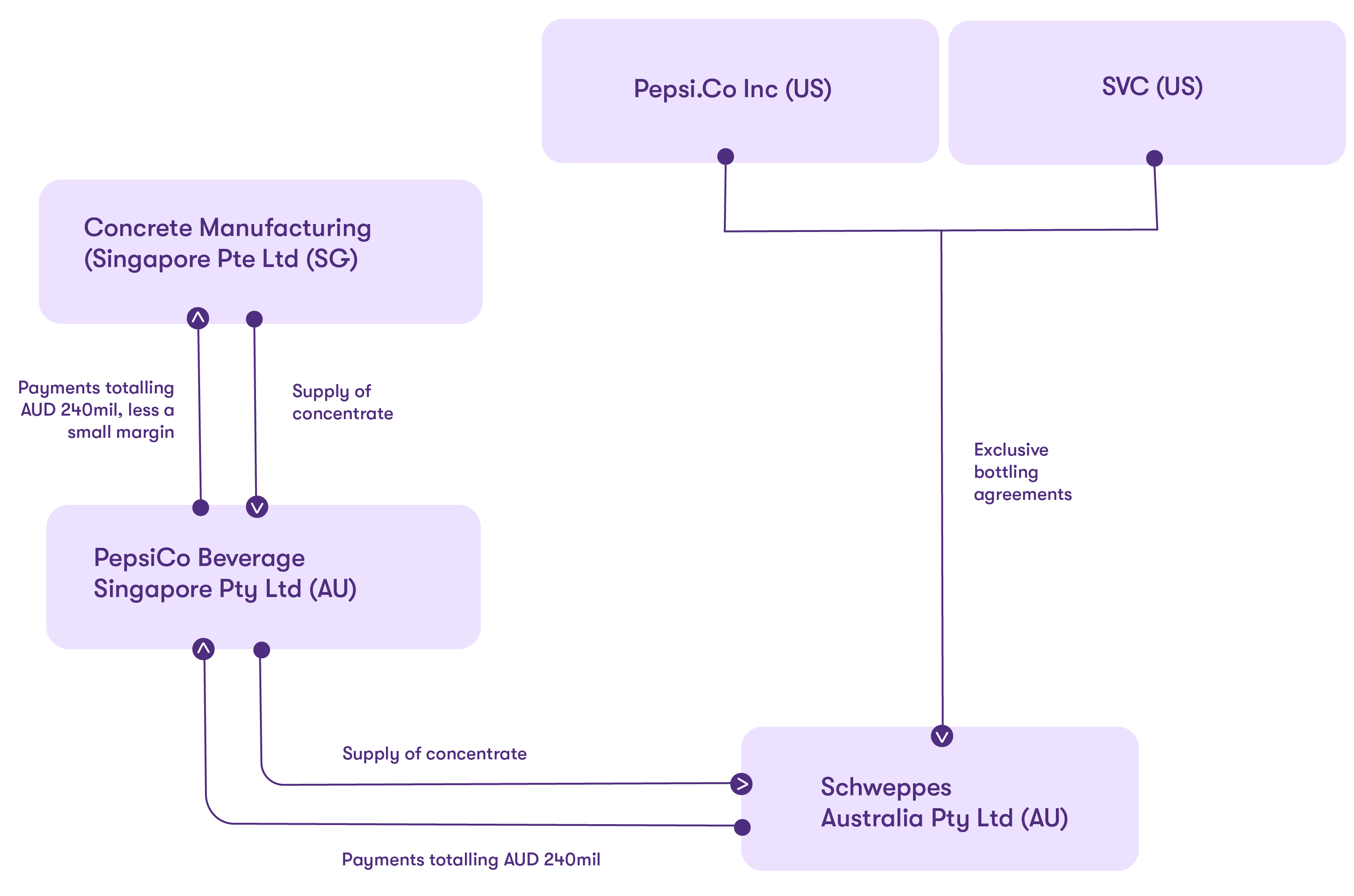
As summarised in our prior article, PepsiCo and SVC entered into Exclusive Bottling Agreements (EBAs) with an Australian third party, Schweppes Australia Pty Ltd (SAPL). Under the EBAs, PepsiCo and SVC agreed to sell or nominate a related entity to sell beverage concentrate to SAPL. SAPL was to manufacture finished beverages using the concentrate, bottle, package, and sell the products to customers. In performing its activities, SAPL was granted access by PepsiCo and SVC the rights to use trademarks and other intellectual property (IP) associated with the beverages. However, per the terms of the EBAs, SAPL was to make a payment for the purchase of concentrate only. This payment was to be made to the entity supplying it with the concentrate. At the end of 2015, PepsiCo and SVC nominated Concentrate Manufacturing Singapore Pte Ltd (CMPL) to be the seller of the concentrate. CMPL was to sell the concentrate to PepsiCo Beverage Singapore Pty Ltd (PBS) who on-sold this to SAPL. As per the terms of the EBAs, SAPL made payments to PBS for the concentrate.
The original decision (November 2023)
Mohinsky J agreed with the Commissioner that the payments made by SAPL for the concentrate were in part “consideration for” the right to use IP. In addition, despite SAPL not making any payments directly to PepsiCo or SVC, the Court agreed that the payments for concentrate were income “derived by” and deemed to have been “paid to” PepsiCo and SVC. On this basis, it was found that a component of the payments should have been characterised as royalties, and royalty withholding tax was therefore payable by PepsiCo pursuant to Section 128B(2B) of the Income Tax Assessment Act 1936 (ITAA 1936).
It was also contended that, had the royalty withholding tax provisions not applied, the DPT (40 percent penalty tax rate) would have instead applied pursuant to Section 177J of Part IVA of the ITAA 1936, as PepsiCo and SVC had obtained a tax benefit in connection with the scheme and had entered into the scheme for the principal purpose of obtaining this tax benefit.
Key takeaways from the appeal decision (June 2024)
Royalty withholding tax
- In determining whether the payments made by SAPL for concentrate were in part “consideration for” the right to use PepsiCo and/or SVC’s intellectual property, the Court held it is necessary to look at the “proper construction of the EBAs”. In this regard, it was concluded that legal form is critical to delineating the character of a payment. As there was no express payment referred to in the EBAs for the use of trademarks and other intellectual property, it was determined that the payments made by SAPL were solely consideration for the sale of concentrate.
- The Court sought to identify the central premise or disposition of the EBAs, which was to grant SAPL the right to distribute beverages in Australia. The licensing of intellectual property was found to be “merely a part” or ancillary to this arrangement.
- Although The Commissioner had previously successfully argued that trademarks and other intellectual property were “granted for nothing” by PepsiCo and SVC under the EBAs, the Court differentiated between species of intellectual property rights and found that both SAPL and PepsiCo/SVC greatly benefited from the granting of the licence where:
- SAPL benefited from being able to use the goodwill attached to the trademarks, and
- PepsiCo/SVC benefited from having SAPL “sustain and promote their goodwill” in Australia.
Further, the EBAs imposed significant restrictions on SAPL’s ability to use the trademarks:
-
- SAPL was bound to use the trademarks only for the purpose of distributing PepsiCo/SVC’s particular beverages which were made in the precise way dictated by the EBAs,
- SAPL had restrictions pertaining to marketing with respect to how it used the goodwill and could not embark on its own brand strategy, and
- Rights of inspection, reporting, and testing were granted to PepsiCo/SVC and the burden this placed on SAPL to comply.
Given the above, the Court took a complete view of the licence granted by PepsiCo/SVC to SAPL and rejected the notion that PepsiCo and SVC granted the right to use trademarks for nothing unless the concentrate price embedded some value for it.
- While the Commissioner referred to three agreements where a royalty was charged by PepsiCo for the right to use a trademark, the Court distinguished these agreements from the EBAs in question as those agreements did not include the supply of concentrate by PepsiCo. It was determined in the absence of sales of concentrate, the trademarks were the only available property from which PepsiCo could generate revenue.
- PepsiCo and SVC nominated a seller for the concentrate (as they had the right to do) and SAPL made payments to the seller. However, the Commissioner successfully argued in the original hearing that the monies had been ultimately received by PepsiCo/SVC because there had been a payment by direction. On appeal, the Court concluded that an antecedent monetary obligation owed by SAPL to PepsiCo/SVC was integral for there to have been a payment by direction. As this element was lacking, the payments did not “come home” to PepsiCo/SVC. In addition, it was highlighted that The Commissioner had not reasoned that the seller was PepsiCo/SVC’s agent for the purpose of the sale. If The Commissioner had claimed this, the appeal judgement insinuated the outcome on this matter may have been different.
DPT
- The DPT applies where a scheme is entered into, and one of the principal purposes for entering into that scheme is to obtain an Australian (and potentially, foreign) tax benefit. In this case, The Commissioner contended the scheme was PepsiCo and SVC’s entry into the EBAs whereby no payment was charged for the use of IP.
- The Commissioner advanced two counterfactuals as alternate postulates, i.e., had the scheme not been entered into, the EBAs might reasonably have been expected to have:
- expressed payments made by SAPL to be for all property provided (and promises made by) the PepsiCo entities (rather than for the concentrate alone), or
- provided that the payments made by SAPL included a royalty for the use of, or right to use, the relevant trademarks and other IP.
- In determining whether either counterfactual was a reasonable postulate, the Full Court had regard to “commercial and economic substance”. They considered the commercial and economic substance of the scheme and the commercial and economic substance of both postulates to determine whether these corresponded. Upon examination, it was concluded the commercial and economic substance of the scheme was that the price paid by SAPL was for concentrate and only concentrate. In contrast, the commercial and economic substance of both alternative postulates included payments for concentrate and IP rights. In this regard, the Court concluded that the alternative postulates were not reasonable and therefore PepsiCo and SVC did not obtain a tax benefit "in connection with a scheme" for the purposes of Section 177J.
- Having obtained no tax benefit, it was subsequently found that PepsiCo and SVC could not have had a “principal purpose” of obtaining a tax benefit when entering into the scheme. However, had a tax benefit been found to exist, the Full Court agreed with the trial judge that requisite purpose was established.
Minority view
With respect to royalty withholding tax, Colvin J reasoned that the whole of the terms of the EBAs should be considered (rather than just the express terms) and he concluded at least part of the payments made by SAPL were “consideration for” the right to use IP and therefore a royalty. However, he agreed with the majority that the payments were not income derived by PepsiCo and SVC.
Following on from the above, Colvin J found the EBAs did result in a tax benefit. He contended that although PepsiCo and SVC had nominated a related entity to sell the concentrate and therefore receive payments under the EBAs, a reasonable alternative postulate was for these entities to enter into the EBAs which provided for a royalty to be paid to PepsiCo and SVC.
Summary
Recommendations for impacted taxpayers
All taxpayers with cross-border arrangements involving intellectual property should take note of this outcome, and:
- Ensure there are legal agreements in place covering key dealings, which clearly articulate the rights for each party to the agreement.
- Maintain contemporaneous evidence of the commerciality of arrangements, and in particular, arrangements involving the potential exploitation of intellectual property. To the extent documentation is prepared, this should have regard to the relevant ATO guidance on this topic and provide support for the economics of the consideration paid if this is considered to be non-IP related.
- Where possible, maintain evidence about the manner in which an arrangement is entered into i.e. is there negotiation involved on pricing, what is the rationale for entering into the agreement for both parties, are both parties receiving benefits etc.
Concluding remarks
While the outcome of this appeal casts doubt on the idea of “embedded royalties” by ultimately upholding the legal form of the agreements, intellectual property will continue to be a focus area for the ATO going forward (particularly having regard to the special leave application just lodged). Further, the 2024-25 Federal Budget announced in May 2024 outlined a penalty for Significant Global Entities found to have mischaracterised or undervalued royalty payments. With this new penalty to apply from 1 July 2026, only time will tell how this provision and ATO activity in this area will play out.
Learn more about how our Tax services can help you
Tax Agents Disclosures
The Tax Practitioners Board maintains a register of tax agents and BAS agents. You can access and search this register here.
Your engagement letter with Grant Thornton and the Standard Terms and Conditions set out our procedures for dealing with problems or complaints. The Tax Practitioners Board also has a complaints process in relation to tax agent services as outlined on their website which can be accessed here.
Section 45 of the Tax Agent Services (Code of Professional Conduct) requires Grant Thornton to notify you if it becomes aware of any matter which could significantly influence your decision to engage us or to continue to engage us in relation to the provision of tax agent services. Grant Thornton is not aware of any such matters.