The healthcare system in Australia is not without its challenges. There are lots of moving parts, with a complicated web of primary health networks, primary care, allied services and the private health insurance sector all delivering what should be a holistic healthcare service – and shared responsibilities between Federal and State Governments in providing funding and implementation.
In our ‘Federal Budget: A 10 year retrospective’ report we have kept health and aged care together because there are so many interdependencies. This broad sector has always been one of the Government’s largest expenses – with over 25.5 million Australians, it’s a significant budgetary commitment.
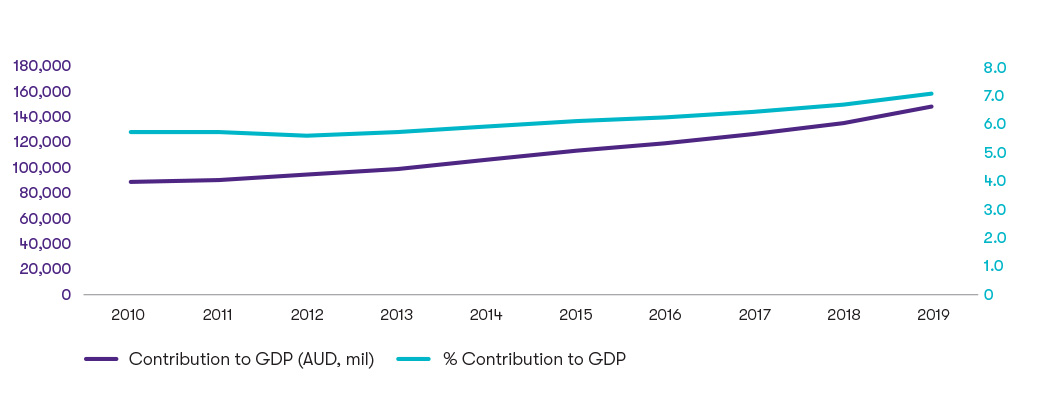
You can see in the following graph that the gap between contribution to GDP as a percentage and as a dollar value is narrowing. It’s a significant contributor, but the dollar doesn’t go as far as it used to. We need that dollar to work harder.![GTAL_2020_HAC_FB_Graph.jpg]()
Cause for optimism in a COVID-normal world?
Health and aged care wasn’t ignored during the Federal Budget, however, it wasn’t the main beneficiary. A total spend of $93.8b to ensure access to essential medical, pharmaceutical and hospital services is indeed an increase of almost 43% since 2014-15 but does not address the areas of vulnerability in the aged care sector. It’s not targeted enough. The sector requires significant new capital, and that investment will not be made until there is increased certainty in funding that allows investors to make adequate returns. Is there cause for some optimism? COVID has pressed the pause button on the economy and made us focus on health. It provided opportunities to invest in innovations and services at levels and with a speed and agility we hadn’t seen before. The opportunity here is to take this short-term focus and make it a long term priority.
In our report we cover:
- Keeping pace with Australia’s ageing population
- Digital healthcare
- Supporting the diaspora
- Where is healthcare’s future workforce going to come from?
- Aged care reform and investment
- Redesigning the aged care industry for the future
- So where to from here?
![GTAL_2020_Federal-Budget-2020-21.jpg]()
Looking back to look forward
We were initially writing the ‘Federal Budget: A 10 year retrospective’ report before COVID-19 as an advocacy piece for more industry investment and support. Of course, the way the year started is not the way the year is ending. Many sectors that had been left to their own devices are now key for our recovery. Sovereign capability. Jobs. Digital economy. Modern manufacturing. Renewable future. Deregulation. Innovation. These are the terms we will use as we settle into COVID-normal.
Our report looks retrospectively at 13 different industries, the investment made into them by Government and their contribution to GDP. This is then overlaid with the opportunity we see for industry in this new normal based on recent Government announcements.
Download report