Once upon a time, certainly in living memory, Australia had a thriving and diverse manufacturing sector. The sector peaked in the 1960s with manufacturing representing a quarter of Australia’s GDP. We had a thriving textiles sector, processed our own produce and manufactured our own cars. There were no international trade deals like there are now.
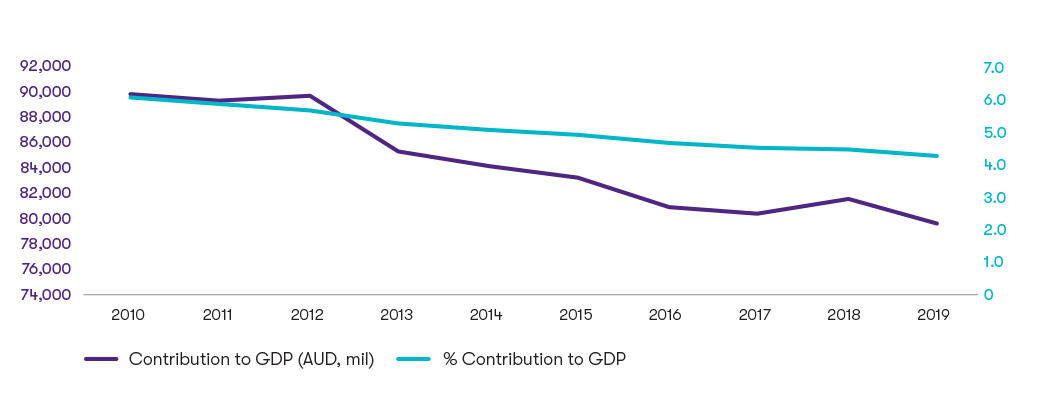
The data we have from the last 10 years as part of our ‘Federal Budget: A 10 year retrospective’ is a small and sobering piece of a much larger story. In 2010, the contribution to GDP was 6%, and over the decade it has declined to 4.21%. We saw majority of manufacturing moved offshore, particularly into South East Asia, to take advantage of lower cost economies.
Previously a powerhouse of Australian employment in the 30 years prior, Australian manufacturing only represented 8.6% of employment in 2010 – and 10 years later has decreased to 7%, or 852,800 people. In 2020, it was found that Australia now ranks last on the OECD rankings for manufacturing self-sufficiency – making us the most underdeveloped manufacturing sector of any industrial country in the world.![GTAL_2020_MANU_FB_Graph.jpg]()
A manufacturing renaissance?
Excitingly, one of the largest investments in the Federal Budget – and in stark contrast to past investments in the manufacturing sector – is the $1.5b manufacturing strategy, including a significant $1.3b modern manufacturing initiative. In this, Scott Morrison has pointed to the strategies employed in Singapore, the UK, Germany and Canada – leveraging home-grown manufacturing in specific areas of strength. The message to the Australian market is that it’s not about what we make but how we make it and how we commercialise it.
However, what does this look like in action? We know the Government will invest in manufacturing where we are already strong and can compete globally. Locally, there is opportunity as well. The Government is the largest procurer in the Australian marketplace, and there is a real opportunity to drive investment in the sector simply by placing their dollar here. According to the National Association of Manufacturers, with every $1.00 spent on manufacturing, another $2.74 is added to the economy.
In our report we cover:
- Modern manufacturing initiative indicates a pivot point for sovereign supply chains
- The multiplier effect
- Keeping R&D innovations in Australia
- Reliable, low-cost energy will be key to the success of Australia’s manufacturing industry
- So where to from here?
![GTAL_2020_Federal-Budget-2020-21.jpg]()
Looking back to look forward
We were initially writing the ‘Federal Budget: A 10 year retrospective’ report before COVID-19 as an advocacy piece for more industry investment and support. Of course, the way the year started is not the way the year is ending. Many sectors that had been left to their own devices are now key for our recovery. Sovereign capability. Jobs. Digital economy. Modern manufacturing. Renewable future. Deregulation. Innovation. These are the terms we will use as we settle into COVID-normal.
Our report looks retrospectively at 13 different industries, the investment made into them by Government and their contribution to GDP. This is then overlaid with the opportunity we see for industry in this new normal based on recent Government announcements.
Download report