Largely left to operate on its own, the resources sector has been a stalwart of the Australian economy. Treasurer Josh Frydenberg in the Economic Update in July said that the mining sector is the shining light of the Australian economy.
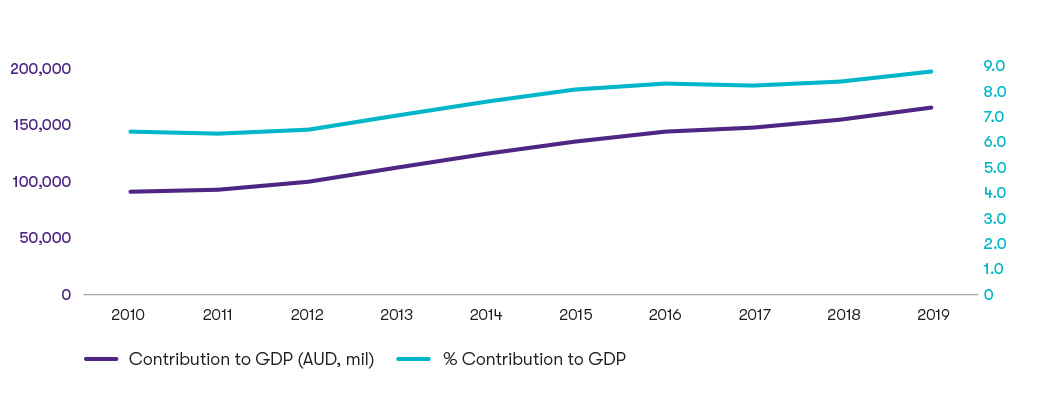
The last 10 years has seen the 2000s resources boom stabilise, and the sector has not been without its controversy, with native title battles, environmental lobbying and workplace health and safety issues to reckon with. Yet the sector continues to trend upwards without a boom to propel it forwards.
The great blind spot is our exports. The Productivity Commission estimated in March this year that Australia exports close to 90% of the commodities it produces. We produce more gas per capita than any other country, yet locally, our gas prices are double that of anywhere else. A better balance between international export and domestic supply is on the horizon.![GTAL_2020_Resources_FB_Graph.jpg]()
“Industrial parochialism”: not necessarily a dirty term
It’s clear that the industry has largely funded its own investments. The result has been an allocation of investment to large projects focused on global markets like iron ore, coal, and LNG. To change this focus and increase investment focused on the domestic market requires the Government to make changes to key challenges faced by the resources industry including access to resources, complex regulation and investment incentives. The recently announced National Gas Infrastructure Plan is a welcomed start. There is a clear need to both increase the volume of available gas and decrease its cost. Other opportunities presented by the Government include the $1.3b modern manufacturing initiative and $18b Technology Investment Roadmap, providing opportunities for resource industries like lithium, nickel and copper.
In our report we cover:
- A picture of self-sufficiency
- Are regulations killing commercial viability?
- Are border closures and working under COVID-Safe stifling business?
- Looking inward to secure Australia’s future
- So where to from here?
![GTAL_2020_Federal-Budget-2020-21.jpg]()
Looking back to look forward
We were initially writing the ‘Federal Budget: A 10 year retrospective’ report before COVID-19 as an advocacy piece for more industry investment and support. Of course, the way the year started is not the way the year is ending. Many sectors that had been left to their own devices are now key for our recovery. Sovereign capability. Jobs. Digital economy. Modern manufacturing. Renewable future. Deregulation. Innovation. These are the terms we will use as we settle into COVID-normal.
Our report looks retrospectively at 13 different industries, the investment made into them by Government and their contribution to GDP. This is then overlaid with the opportunity we see for industry in this new normal based on recent Government announcements.
Download report