Jessica Fox
I'm Jess Fox. I've spent my life chasing remarkable. In this series, I'm meeting the people doing the same in business, in life, and in their communities.
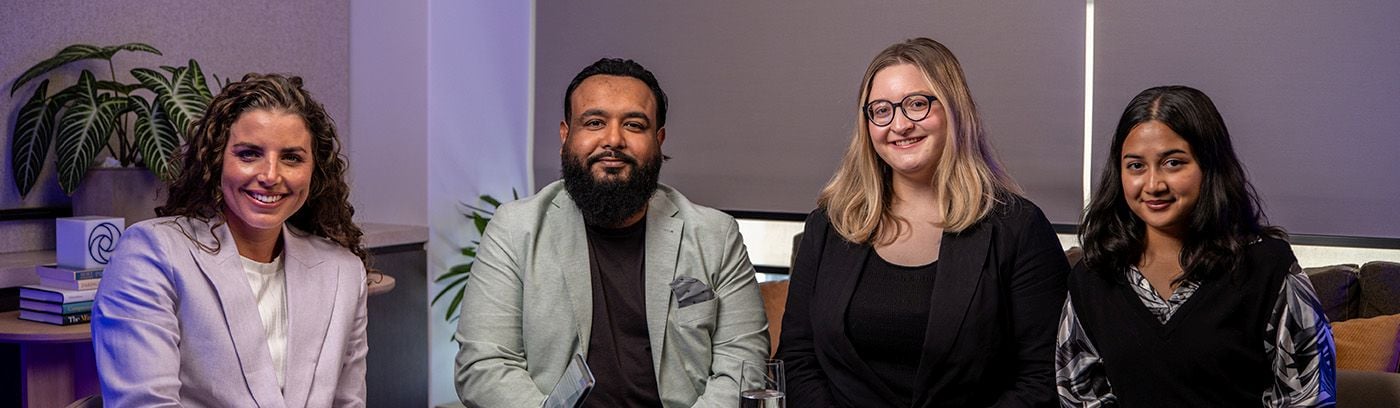
Every year, thousands of young people come to Australia to study. For many of them, it's their first time far from home in a new language under real pressure. Mental health support exists but getting to it in a system you don't understand in a language that isn't yours is a whole other challenge. Ali Rahman leads a team at headspace, working to change that with support from the Grant Thornton Foundation, and he's bought two of the people helping him build it – Tanish and Rachel, international students themselves. I wanted to hear their story.
Ali, Tanisha and Rachel, thank you so much for joining us today. I'm really looking forward to chatting all things mental health, headspace and the barriers facing international students and everything that you're doing to support them.
I guess a question to open to you all before someone can even ask for help. They have to believe that help is there for them.
So, for a young international student in Australia, how often does that feel true.
Ali Rahman
I think you put it absolute and put it well. People do have to believe help is for them to engage in help seeking or at least, hope that help is for them. I think when it comes to international students, there are so many barriers that they face through the systems.
It might be visa navigation; it might be the housing system, the employment system. One of those systems that are difficult to navigate is the mental health system. And to be completely honest, I think we need to do better in that mental health system to ensure that international students can believe it's for them.
And to do that, I think we need to ensure that our services are more safe, more culturally responsive, more inclusive, and the international students feel like they can belong. I think, for us, those are the steps working towards being remarkable. And Tanish and Rachel, does that speak to what you're seeing and hearing from international students out there?
Tanish Tanjil
Yeah, definitely, we, did as a part of our work, we actually spoke to those 70 students and, it honestly resonated that it just wasn't our story. It's story of the community, and, yeah, to represent that work, and to make that resource with them is honestly truly amazing.
Rachel Delmar
I think something that both of us, experience and that we've come across when talking with international students is that we as international students don't often have the words to describe what we are feeling.
We may understand that we're feeling stressed, lonely, or overwhelmed, but may not recognise that those are things that we can get support for. I also think that international students, we understand that we're doing something that's very difficult and tough, and so we often try to just persevere through whatever we're going through thinking that, yeah, we can do this, we can overcome this.
And just, you know, trying to go through whatever we're experiencing, which can cause us to sort of neglects other feelings. And so, I think that can be a barrier to health. And we just want international students and ourselves to internalise that, it's okay not to be okay. And that support is a necessary part. It's part of your overall health.
And yeah, that feelings of loneliness, being overwhelmed, feeling stress that is part of being an international student and that there is support out there for us, for other international students.
Jessica Fox
You mentioned, you know, accessing mental health or being aware of mental health services that are out there is a challenge in itself sometimes. But when you add in those barriers that that you mentioned the visa requirements, not just the language barrier, the housing, it all adds up. It all stacks up.
So, what is it that you're trying to change to help break down those barriers and support them?
Ali Rahman
I think, like I said earlier, a lot of the challenges are systemic, I think, and what we can do on that part is advocate for international students. But unfortunately, there are so many gaps in the systems that so many international students are falling through all those gaps.
What we're trying to change as well, we can immediately address those gaps. We can let international students know that, “Hey, we're here for you. We've got your back. You don't have to navigate those gaps on your own.”
And we’ll support you so you don't feel like you have to fall through those gaps.
And that looks like a missed link to international students understanding what's important to them, and then what we've done for this project, co-design, support around those needs.
Jessica Fox
So, who is helping you fill those resources you mentioned? You know, it's not just a project that's designed for international students. It's designed with them. That's right.
Tanish, she came to Australia as an international student yourself, and now you're part of building what headspace offers to other students like you were.
So, what do you say that needed to change? How are you helping this project?
Tanish Tanjil
So, I feel like what needed to change was that the resources that we're making or the information that's out there, it's easy to understand. It's accessible and it's actually digestible for students because, you've got students, like I'll speak about myself.
So, when I first came to Australia, like I was just overwhelmed by the amount of things that's out there. So you've got new systems, and like Ali mentioned, visas, finding your own house and superannuation. I'm like, what are these things like? I genuinely didn't know about any of it because I just came from high school and so navigating all of this and I won't lie, there are resources.
You've got headspace and even, the uni that I study in, which is University of Sydney, we had cohort welcomes and in those cohort welcomes we were provided with the information, but you've got so many things happening at the same time, and you've also got your studies coming up and to balance four units of study altogether and also navigate your mental health. It's a lot.
So, I feel like that information doesn't reach the student, like it doesn't meet the student at the right place at the right time. And even if it does, you've got those language barriers where students are met with all these like incredibly tough jargon that they have to navigate to even access that help. And to top it all off, you've also got financial stress.
So, I come from a background where, I'm sort of slightly financially limited, so it's honestly hard for me to reach that mental health care. And I didn't know about headspace before interning with headspace, but our insurance doesn't cover mental health care, so we've got health insurance as a student, but it doesn't cover mental health care. It covers a GP to an extent.
Jessica Fox
So that makes it hard as well. So, all these things just mushed together for a student. It's a lot. And that needs to change.
Definitely. I mean, it's hard enough for a local student to navigate those systems, but let alone an international student. I'm sure you're really, you know, contributing to that change and supporting others to learn from your experiences.
Rachel, what has it meant to you to work on something that's for people in your own position?
Rachel Delmar
Yeah. So, it's really meant that I'm a change maker and I'm sort of serving as a mentor for current and future international students. It just means a lot that knowing that I'm making such a difference when it comes, for an international student’s journey when it comes to mental wellbeing and work and study.
Me and Tanish, we both personally have like particularly struggled when it comes to just wellbeing and work and study during our time as international students so far and some of our peers.
And we really recognise that this was an area where international students need more assistance. So, just being able to be part of a project where we're helping future international students and also, like I said, current ones navigate this complex system just really means a lot, knowing I'm making a difference.
Jessica Fox
Yeah.
Rachel Delmar
It really warms my heart knowing that I am contributing to something bigger than myself.
Jessica Fox
That is empowering, I’m sure. And it sounds like you've got a fantastic team of people around you. We've heard how you know you're using your experiences on this project, and you know this project was passionately sponsored by Grant Thornton, because a lot of Grant Thornton people came to Australia's international students as well. So, it really spoke to them to be involved in this way.
So, what do you make of the fact that it resonated with the firm so personally?
Ali Rahman
It makes a huge difference. I think the fact that it's personal adds so much meaning to it. I mean, just look at us now, where we have our international students who have a seat at the table, have a voice and are being recognised for the work that they're doing.
How powerful is that? How empowering is that?
Like you mentioned, I think when something's personal, it goes beyond numbers and KPIs. It becomes a power for change.
And I think sort of that sentiment, I imagine the staff are going to have their own lived experience with being international students and wanting better for future cohorts. That passion, that energy is something we feel a headspace and feel very aligned with as well.
We've got many staff who are also, have that lived experience of being international students and through that shared passion, that energy, we've been able to make change through really being able to meaningfully engage with international students. And in terms of engagement – with more than 70 plus international students listening to their stories and what they need.
It's meant that we've been able to present the work at national health conferences and ultimately the energy that that's come from the stops being contagious. It's opened up conversations in the wider organisation. How can we do better for international students overall? It's it started a conversation with other organisations. How can we as a system do better for international students?
So, I think the fact that it's personal just adds so much power to it.
Jessica Fox
Yeah, that shared experience turns into collaboration, and you can achieve so much more when you work together.
Ali Rahman
Absolutely.
Jessica Fox
So, when you picture getting this right for one young person, what does that look like?
Ali Rahman
There's on, sort of story that sort of stuck with me.
One of the things we've been able to do, with the support of The Grant Foundation, is translate, resources into different languages, and there's heaps of translated resources out there, but what we often hear from international students is that, well, these are just directly translated. The words are just directly translated. But what's often missed is the translation of meaning, the translation of the essence of the topic, but in a way that makes sense to the individual and the way that people communicate.
And one of our engagements with the university, we had a stall, had our our resources out and a Nepalese international student came up to the stall, picked up a resource, and you could say you his eyes lit up and he was like, “Oh my God.”
We were like, “Oh, what's what's going on?”
He's like, “We talk like this. This is how we talk.”
We were like, “Oh no way, tell us more about it.”
“Yeah, usually when I pick up stuff is just it still sounds jargony even in our own language. Doesn't make sense. But this is how we talk to one another.”
And then that started a conversation about mental health.
That resource was almost an invitation that we see you, we hear you, we listen to you, and we want to invite you to our service. We’re someone that you can come to for support. I'm sure he's, going to tell his friends about it, and it's just going to open the door with that community.
Jessica Fox
That's when you know you've got it right, because you connect with them where they're at and you meet those, you know, language and cultural needs that they have as well.
So, what does remarkable look like for you in your mission?
Ali Rahman
Yeah, I think just sort of, bouncing off that, I think being remarkable also feels like a responsibility.
So, when we've got young people who've travelled far, made so many sacrifices, are going through so many challenges when they feel comfortable, safe, enough to reach out to us for support and feel like we're trustworthy enough to take on that responsibility.
For me, that's us working towards remarkable.
Jessica Fox
I can I can say a lot of nodding, and I'm sure you know the work that you're doing is making such an impact in so many communities. And, you know, especially for these international students to be able to thrive here in Australia. So thank you for your time today and for joining us.
Ali Rahman
Thanks so much for the opportunity.
Jessica Fox
You've just heard what remarkable looks like in their world. What does it look like in yours? Thanks for coming along. There are more journeys to meet, and I'll see you at the next one.