As the first and second generation work on and in the business, it’s crucial to try and keep it alive – to uphold the legacy and ensure the business thrives for future generations.
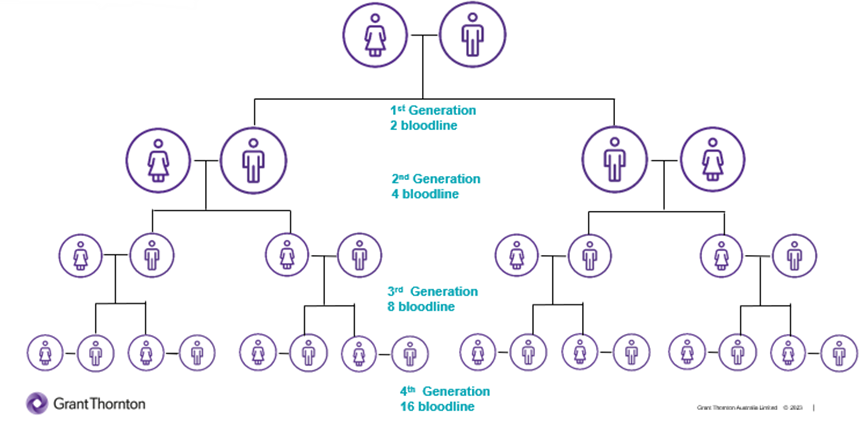
However, this sustainable legacy can sometimes be challenging to create. As the family tree shows below, once you look at third generation and beyond, families become larger. More complexities can need to be considered such as divorces, remarriages, step-children, blended and aging families. The family element in a family business starts to become very complex. You will begin to see family members in the business and family members removing themselves from the business.
![]()
How do you effectively communicate with so many family members?
Family Council Meetings ensure there is clear and concise communication with all family members. They allow an opportunity for the family members to informally learn from their parents, while discussing opportunities and challenges they have experienced in the last quarter. Having an independent facilitator brings a level of professionalism as they ensures dates are set, agendas are presented, everyone has a voice and – in many instances – means everyone remains professional too.
So, what makes a family council meeting effective?
Family Council Meetings are pivotal in fostering transparent communication among family members, mitigating negative perceptions of other family members, and fostering a more positive outlook on relationships within the family.
Below are some ways to ensure Family Council Meetings remain effective every time you come together:
- Consistent frequency – bi-annual, quarterly or bi-monthly
- Independently facilitated
- Set agenda
- Report packs provided prior to the meeting
The power of a Family Charter
An effective tool to use in your Family Council meetings is a Family Charter or a ‘family rule book’. This provides clarity between family members and ensures fair and equitable treatment. Conflict is also mitigated by working together to create your Family Charter. It ensures that the family values are not only aligned but strengthened. So, in challenging times, each family member has the foundations and core values to fall back on and overcome as a united front.
The Family Charter goes hand in hand with formation of a Family Council. Family governance enables the family business and Family Office to run more professionally.
We’re here to help
Our team can assist your family with building a governance structure that suits your family and business, with your family values at front of mind. As independent facilitators, we work closely with you to identify key issues and develop a framework which considers the objectives of your whole family. If you’d like to know more, please reach out to your Family Business Consulting representative today.
Learn more about how our Family business consulting services can help you