Generally, when we talk with family businesses about the next generation ‘taking over’ we break this down into two parts – management and ownership. The first step would be to understand what part your parents are referring to when they’ve told you to ‘take over’ – it could mean management, ownership, parts or both. Every business – like every family – is different and what this means in one family business may be completely different in another.
Family business survey insights
The Family Business Survey 2021 noted that 65 per cent of those with succession plans intend to transition the business to a family member. The results also found that 52 per cent of businesses who were planning transition out of their businesses already had someone in mind, with 73 per cent believing the potential successor was ready to take over.
Further to this, over the next four years, 57 per cent plan to transition management and 40 per cent plan to transition ownership. These statistics highlight the importance of understanding what ‘taking over’ means for the current and next generation family members.
The first step
Begin by talking with your parents and discuss their intentions. It would be helpful for you to approach a discussion as prepared as possible – so come ready with your questions. In some cases, you may already be working in the family business, so the questions you ask will be different to ones that a relation outside of the family business would ask. If you currently work in the family business, we have listed examples of questions you may ask below.
- What aspects do you want me to take over in the business? Does this eventually include ownership?
- Note: It may be a management role, a key leadership role, a departmental or divisional role – or is it only an ownership/shareholder role?
- What education or training do you think I need to be successful at taking over?
- What is your expected timeframe for me to be ready to do this?
- What/how do you see your role changing over this time? Do you expect to be able to exit completely or only partly?
- What would need to be demonstrated for you to show the transition was successful?
- What are your intentions with the ownership of the business? What do you want to happen? Is there an expectation to fund my entry into ownership myself?
It may be that your parents aren’t ready or able to answer all your questions and may need more time to consider what they want, or they need to engage with their advisors to assist. If there are other family members – either working in the business or who may have an expectation to be involved in these conversations – you should consider at what stage in this process they should be included. There may be sensitivities with some family members being involved in these conversations, and others not being included, so it is important to tackle these issues early.
Next step: actionable items and goals
Once you understand what your parents want you to do as well next steps and timeframe for taking over the family business, then you can break this down further into actionable items and goals – you should have subsequent ‘check-ins’ with your parents to see how you are tracking.
For example, if your parents would like you to undertake some technical or industry training, you can determine what the appropriate training is, who is to deliver it, and how you might be able to demonstrate to your parents that you’ve achieved that objective.
How to ensure successful transition ownership
Ownership transition can be an especially sensitive topic, particularly if there are other family members involved. It may not be unreasonable for your parents to expect you to fund your entry into the ownership structure of the family business. For many people their family business is their largest asset, and their exit may be their only means to fund retirement. This can be a difficult conversation for many families, and in some cases may need support from financial, taxation and legal advisors to understand and determine the most effective way to transition ownership.
Successful transition of management and ownership will generally come down to clear and transparent conversations between all interested parties. This can take time – even years in some cases – and will likely require your external advisors to be involved in different stages of the process to achieve the best outcome possible for all parties.
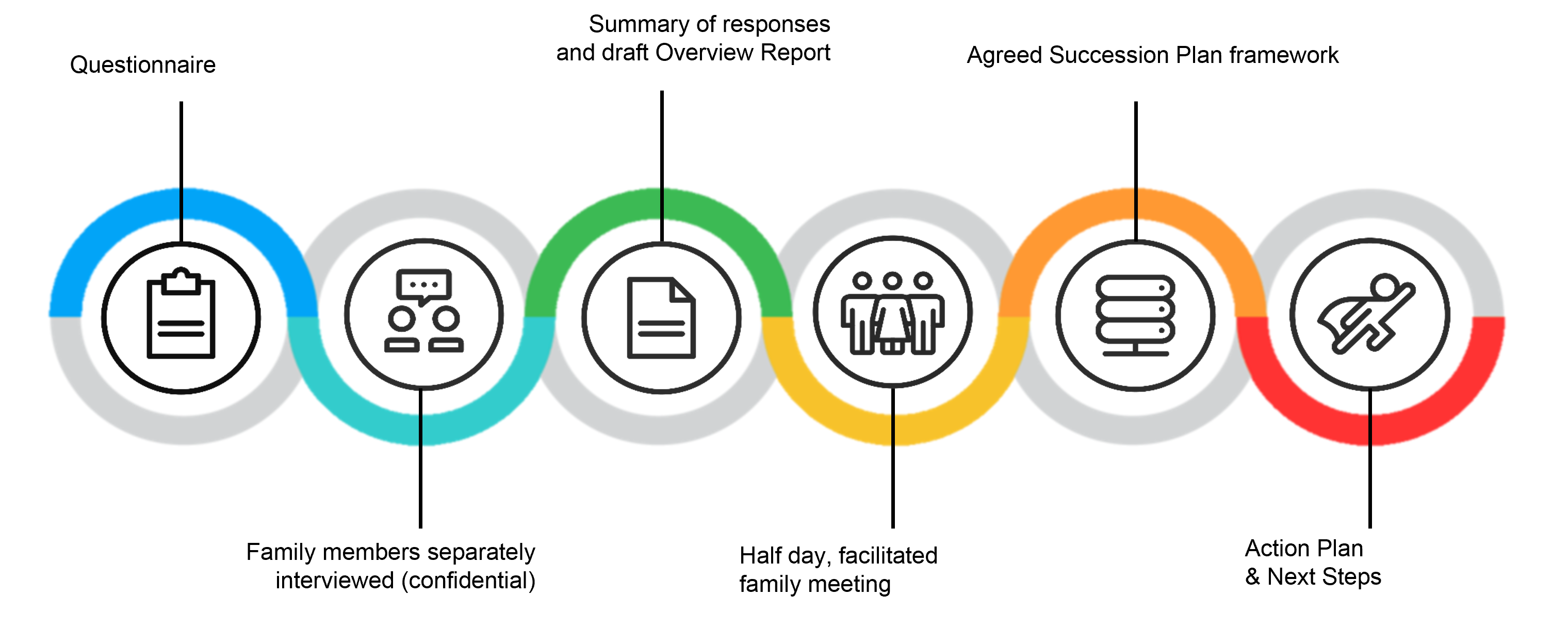
Our process
Our succession plan process will provide detailed step-by-step process to identify how you can successfully transition the business to the next generation.
![]()
How can we help you with your transition?
Are you considering transitioning your ownership to the next generation in a few years? Are you in the initial stages of transition? We’ve had experience with many clients, all facing different family business challenges when it comes to transition planning. No matter your timeline, our tried and tested methodology developed out of our Family Business Advisory practice can help you determine the best way to transition that will be beneficial to both generations.
Contact our team today for assistance with your family business.