Learn more about how our Tax services can help you

Protecting private wealth through proactive planning
Why tax reform should trigger a broader review of wealth, succession and business risk.
Remarkable Journeys with Jess Fox: Conversations with our clients, people and community. Listen now.
By: David Montani, Cameron Bacon, Yan Wong, Jessica Brass
12 Oct 2026 6 min read
The key question for taxpayers is whether to engage a professional valuer or use the shortcut valuation method available under the new rules.
The legislated capital gains tax changes preserve access to the 50 per cent discount (where available) on the growth of an asset’s value up to 1 July 2027. . The higher an asset’s market value on that date, the greater portion of any future capital gain will be subject to the 50 per cent discount.
As a result, taxpayers will need to determine how they will establish the market value of each CGT asset as at 1 July 2027.
Generally, most assets are subject to the CGT rules. These include:
Our experience is that the last two items listed sometimes come as a surprise to taxpayers.
Assets which are exempt from CGT include cars and your home (where subject to a full main residence exemption). Accordingly, these assets will not require valuation at 1 July 2027.
However, if your home is only partially covered by the main residence exemption, a valuation as at 1 July 2027 should still be obtained.
Additionally, any assets that were exempt as pre-CGT assets (i.e. acquired before 20 September 1985) will enter the CGT regime on 1 July 2027 and will need to be valued as at this date.
Companies have never been entitled to the 50 per cent general CGT discount on capital gains, so the new CGT rules have no impact except in relation to pre-CGT assets per the above. Nevertheless, a valuation of a company and its underlying assets may still be required as at 1 July 2027 to support the determination of the market value of the shareholders' interests in that company.
For assets which do not have a publicly available trading price, there are generally two ways to determine an asset’s market value as at 1 July 2027:
Despite its name, the short-cut method is a nine-step process that applies a daily compounding growth rate, but to only the original first element of an asset’s cost base (later additions do not factor in). Further, the nature of the formula skews the growth toward the end of the ownership period. This is illustrated by the red line in Figure 1, whereby the growth to ‘market value’ as at 1 July 2027 is relatively low.
Alternatively, obtaining a professional valuation may support a higher market value as indicated by the blue arrow in Figure 1. The gap between the blue arrow and the red line is the extra portion of the eventual capital gain on the asset that will be subject to the 50 per cent discount, meaning an expected lower tax bill.
Note that while a professional valuation will provide strong evidentiary support and will be appropriate in many cases, it does not guarantee that the ATO will accept the valuation adopted.
Figure 1: Valuation vs short-cut method
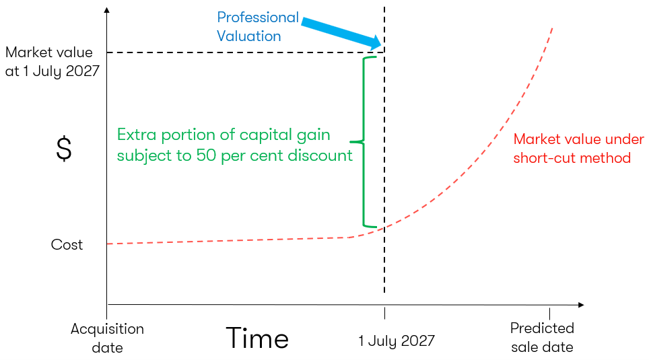
While the example in Figure 1 favours obtaining a professional valuation, taxpayers should weigh the likely tax benefit against the cost of obtaining that valuation. Where the expected tax saving is greater than the valuation cost, obtaining a professional valuation will often make commercial sense.
Grant Thornton has developed a practical modelling tool that compares the benefits of applying the legislated shortcut method to obtaining a professional valuation. By inputting key assumptions, such as the estimated market value of an asset as at 1 July 2027 and the anticipated timing of its future disposal, the tool estimates the potential tax benefit that may arise from obtaining a professional valuation and compares that benefit to the estimated valuation costs.
Where the estimated tax benefit exceeds the cost of the valuation, this may support a decision to obtain a professional valuation. Conversely, where the anticipated valuation cost outweighs the potential tax benefit, the shortcut method may be the more practical option.
The ATO has published guidance on what they regard as constituting acceptable support for an asset’s market value. For example, with real property, you will need a sworn valuation by a licenced property valuer. A market appraisal or ‘kerbside valuation’ by a real estate agent is not sufficient.
For a business, you will need a valuation by a qualified professional business valuer, such as Grant Thornton’s Financial Advisory and Corporate Finance teams.
It is not essential to have any particular asset professionally valued by 1 July 2027. However, there may be additional costs and inefficiencies in getting a valuation after this date. With real property, the longer the period after 1 July 2027 the higher the valuation cost is likely to be, as valuers must undertake more extensive retrospective analysis to determine the property's value as at that date.
For businesses, it will generally be necessary to firstly complete the business’s financial reporting for the 2026-27 year, as this is a necessary input in any valuation.
We’ll be speaking to our clients regarding appropriate tax and valuation advice to help you decide your preferred valuation option for your assets.
If you are not a current Grant Thornton client but would like assistance, or have any queries, please feel free to contact us at Grant Thornton.





Why tax reform should trigger a broader review of wealth, succession and business risk.


R&D Tax Incentive reforms, RDTI reforms, R&D tax offset, innovation incentives, refundable R&D offset, non-refundable R&D offset, supporting R&D activities, Treasury consultation, research and development tax incentive, Federal Budget 2026-27, R&D tax changes, Australia R&D incentives, Innovation Incentives, R&D claims



Outlining key tax considerations for a taxpayer once their aggregated group turnover is A$1 billion or more.


