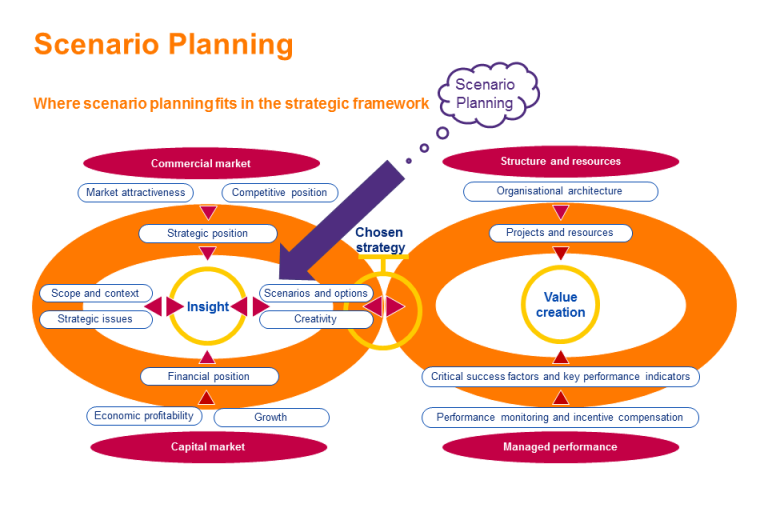
There are a number of methods of stress testing your strategy, however scenario planning offers a clear methodology that allows your Board and executive team to consider environmental variables and explore “upside”, “downside”, and alternative futures in a safe environment. The development of “learning scenarios” often enhances strategy and increases the robustness of organisational thinking.
![]()
Figure 1. Where scenario planning fits into a strategic planning framework
Scenario planning – what is it?
In the manager’s strategic planning toolkit, scenario planning stands out for its ability to capture a whole range of possibilities in rich detail.
By identifying basic trends and uncertainties, managers can construct a series of scenarios that will help to compensate for some common errors in decision making — including overconfidence and tunnel vision.
It operates on the principle that, for some decisions, thinking in terms of multiple possible futures, or scenarios, is more effective than relying on single-point forecasts of the future.
Decisions influenced by multiple sources of uncertainty — where a high-consequence, low-probability event might significantly influence the outcome — are well suited for scenario planning.
Well-crafted scenarios create a “wind tunnel” for designing strategies that are robust across the most important and most uncertain environmental variables. They are responsive enough to anticipate and adapt to the realisation of future events.
What scenario planning can do for you
In short, scenario planning attempts to capture the richness and range of possibilities, stimulating decision makers to consider changes they would otherwise ignore. At the same time, it organises those possibilities into narratives that are easier to grasp and use than great volumes of data. Above all, however, scenarios are aimed at challenging the prevailing mind-set.
Scenario thinking is useful because it forces individuals to step outside their assumptions about the future and recognize that many things they consider predetermined are actually uncertain. Thus, scenario planning prevents groupthink from developing around a single possible future.
Scenario planning attempts to compensate for two common errors in decision making:
- under-prediction of change, and
- over-prediction of change
Most people and organisations are guilty of the first error. Although change in all aspects of our lives is accelerating dramatically, we tend to imagine the future without such a rate of change.
Who benefits
Scenario planning workshops have created real benefits for clients in a rapidly changing world, including our recent work with a seniors living and aged care provider grappling with the implementation of LLLB and CDC, a supplier to the disability industry, responding to the rapid change that the NDIS calls for.