
Quick summary
- Australian entities with annual turnover of A$1 billion or more, whether on a standalone basis or as part of a broader group, may become subject to a range of additional tax obligations. These can include substantially higher administrative penalties and enhanced tax reporting and disclosure requirements.
- Importantly, these rules can apply even where the Australian operations are relatively small. For example, Australian entities that form part of a larger multinational group or are owned by a private equity fund may be within scope despite generating significantly less than A$1 billion of turnover in Australia.
- Multinational groups approaching approximately A$1.2 billion in turnover should also assess their exposure to the OECD Pillar Two regime, which may introduce minimum tax obligations, additional lodgement requirements and reporting obligations relating to global effective tax rates.
This insight outlines key tax considerations for a taxpayer once their aggregated group turnover is A$1 billion or more.
Exceeding this threshold can significantly increase an entity’s Australian tax compliance and reporting obligations, including enhanced administrative penalties and additional disclosure and lodgement requirements. This document summarises the key legislative requirements, thresholds and practical considerations relevant to entities that generate annual turnover of A$ 1 billion or more and outlines the resulting Australian tax implications.
Contents
Significant Global Entities (SGE)
Country by Country Reporting Entity (CbCRE)
SGE, CbC reporting entity and Public CbC: the differences
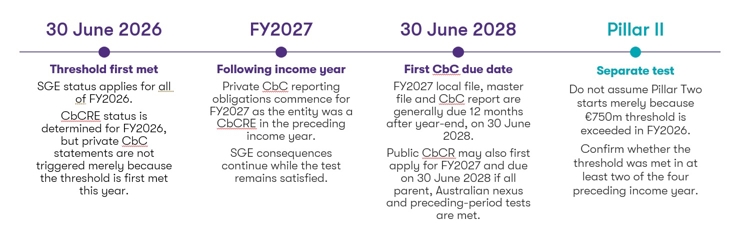
Timeline example: first generating A$1 billion or more in the year end 30 June 2026
Significant Global Entities (SGE)
Key implications once rules apply
No additional forms are required to be lodged with the ATO. It is simply a disclosure on the taxpayer’s income tax return. Although, where an SGE is also a Country-by-Country Reporting Entity (CbCRE) (discussed in the next section) then additional reporting obligations apply.
However, there are various measures applicable to SGEs, including:
- significant Failure To Lodge (FTL) penalties on ‘approved forms’ (effectively all tax lodgements);
- the proposed loss carry-back rules will not apply to SGEs;
- Multinational Anti-Avoidance Law; and
- Diverted Profits Tax.
The current FTL penalties are set out below:
|
Days late |
SGE penalties |
|
28 or less |
$182,000 |
|
29 to 56 |
$364,000 |
|
57 to 84 |
$546,000 |
|
85 to 112 |
$728,000 |
|
More than 112 |
$910,000 |
Country by Country Reporting Entity
Key implications once rules apply
A CbC reporting package will need to be lodged with the ATO. This comprises the following:
- Local File;
- Master File; and
- CbC Report.
The Local File is focused on the Australian entity and its related party dealings. The CbC Report presents aggregated data by jurisdiction while the Master File provides clearer context on value creation across the group. Together, these documents provide the ATO a comprehensive view of the group's global operations and identify potential transfer pricing risks.
The lodgement due date is 12 months after the applicable year end, however, where the local file is lodged when the applicable tax return is due, an exemption applies for completing Part A of the International Dealings Schedule (part of the Income Tax Return form).
Public CbCR
Key implications
A Public CbCR will need to be prepared and lodged with the ATO in the approved form for publication.
Broadly, the report requires taxpayers to publicly disclose certain tax and financial information for Australia and 'specified jurisdictions' such as Hong Kong, Singapore and Switzerland on a standalone basis. Information for other jurisdictions may be aggregated as 'Rest of World'.
The disclosures include:
- a description of the group's approach to tax;
- a list of constituent entities and their tax jurisdictions;
- description of main business activities;
- revenue from unrelated and related parties;
- profit or loss before income tax;
- income tax paid and income tax accrued;
- difference between effective and statutory tax rates;
- number of employees; and
- book value of tangible assets.
Unlike traditional CbC reporting which is lodged confidentially with tax authorities, Public CbCR information will be made publicly available. The regime is intended to increase transparency regarding the global allocation of income, activities and taxes paid by large multinational groups.
The lodgement due date is 12 months after the applicable year end.
SGE, CbCRE and Public CbCR: the differences
|
Issue |
SGE |
CbCRE |
Public CbC reporting parent |
|
Core test |
Worldwide group annual global income ≥ A$1bn. NLCG test disregards specified consolidation exceptions. |
A subset of the SGE population. The CbC group test applies accounting consolidation principles without disregarding all exceptions in the same way. |
The global parent with annual global consolidated income ≥ A$1bn plus Australian nexus and ≥ A$10m Australian-sourced aggregated turnover. |
|
Foreign entities required? |
No. A solely Australian group may be an SGE. |
No. A domestic-only group can be a CbCRE, although it may request the ATO to provide exemptions from certain CbCR statement obligations. |
No, a domestic-only group is still required to lodge a Public CBCR. Exemptions are only provided by the ATO is exceptional circumstances. |
|
When obligations arise |
SGE consequences apply in the year the test is met. |
CbC statements for an income year are triggered by CbCRE status in the preceding income year. |
Applies for reporting periods beginning on or after 1 July 2024, subject to the entity being a CbC reporting parent for the preceding report period. |
|
Main obligations |
Income tax return label, enhanced penalties and specified integrity measures. |
Local file, master file and CbC report, generally due 12 months after year-end, subject to exemptions and information sharing arrangements with other tax authorities. |
Publish selected tax, business and financial information through the ATO, which is made publicly available. Separate from confidential CbC reporting. |
Pillar Two
Key implications once rules apply
Additional reporting and compliance obligations apply for multinational groups, with the intent of highlighting the effective tax rate of each jurisdiction a multinational group operates in.
Where an effective tax rate is less than 15 per cent, then a ‘top‑up tax’ is required to be paid by a group member.
Even where no top‑up tax arises, various lodgements may still be required, including:
- Global Anti-Base Erosion Information Return (GIR): Provides informational on each entity in the group. This is only required where an Australian entity is the Ultimate Parent Entity; or
- Foreign lodgement notification (FLN): where the GIR is lodged offshore; and
- Australian Income Inclusion Rule/Undertaxed Profits Rule Tax Return (Australian IIR/UTPR Tax Return): required even if top-up tax is nil.
- Australian Domestic Minimum Tax Return (Australian DMT Tax Return): required even if the top-up tax is nil.
One form now combines the FLN, Australian IIR/UTPR Tax Return and Australian DMT Tax Return. Relevant sections must be completed even where the resulting liability is nil.
Transitional safe harbour provisions may reduce compliance obligations, particularly in the early years of the regime.
Lodgement due date
All forms are required to be lodged within the following timeframes:
- First fiscal year: 18 months after the year-end.
- Subsequent years: 15 months after the year-end.
Therefore, examples of the first-year lodgement due dates based on year-end are set out below.
|
Fiscal year end |
Lodgement due date |
|
31 December 2025 |
31 March 2027 |
|
31 March 2026 |
30 June 2027 |
|
30 June 2026 |
30 September 2027 |
Whilst the Commissioner has discretion to extend the lodgement date for domestic tax returns, there is no statutory discretion to extend the due date for the GIR or FLN.
Note, if the GIR is being lodged in a foreign jurisdiction and is lodged late, the ATO may require you to lodge the GIR in Australia and FTL penalties may apply.
However, in accordance with OECD guidance, the ATO will not impose FTL penalties during the Transition Period (i.e. 31 December 2026 – 30 June 2028) if entities have taken ‘reasonable measures’ to correctly apply the GLoBE rules. The ATO have said that they will adopt a ‘soft landing approach’ to penalty enforcement where the MNE Group can demonstrate it has acted in good faith and made genuine efforts to understand and comply with the lodgement obligations.
Timeline example: first generating A$1 billion or more in the year ended 30 June 2026
Assumption: the group first satisfies the A$1bn annual global income threshold in the year ended 30 June 2026. Pillar Two is shown separately because its €750m test must be met in at least two of the four preceding fiscal years.
Practical action now:
- Map the worldwide accounting group and PE ownership chain;
- Make sure to consider exchange rate fluctuations;
- Document SGE vs CbCRE conclusions;
- Identify every approved form and owner;
- Assess Public CbC parent status; and
- Test Pillar Two revenue history separately.
Article contributed to by Josie Cransberg – Corporate Tax
Authors
-

Mark Trewhella
Mark is an experienced corporate tax practitioner with over 20 years of experience providing Australian taxation assistance for listed companies, large private entities and multinational groups.View Profile -

Keith To
Keith is a Principal at Grant Thornton with over 15 years of professional experience advising clients specifically in relation to transfer pricing issues.View Profile -

Jessica Brass
Jess is an experienced corporate tax adviser, having worked in both Australia and the UK. She manages a broad client portfolio, from domestic start-ups to large, international groups. Her clients span a range of industries, with specific focus on real estate & construction and energy & resources.View Profile -

Arani Ganendren
Arani is an accomplished Transfer Pricing specialist, with over 10 years of experience in professional services.View Profile
Further information



Client Alert
ATO finalises guidance on Country-by-Country reporting exemptions: Key considerations for multinationals
Following on from our previous alert, the Australian Taxation Office (ATO) has finalised Practice Statement PS LA 2025/2, which sets out their administrative approach to the Commissioner’s discretion for granting an exemption from Public Country-by-Country reporting obligations. These rules require certain multinational groups to publicly disclose tax and financial information.


|
4 min read
|
11 Dec 2025

Client Alert
ATO’s implementation of Public Country-by-Country reporting: what multinationals need to know
The ATO has published its Public Country-by-Country (CbC) reporting implementation guide, effective for reporting periods starting on or after 1 July 2024.
|
6 min read
|
27 Oct 2025

Insight
From compliance to transparency: key developments in Australia’s Country-by-Country Reporting Regime
Australia’s Country-by-Country (“CbC”) reporting regime has evolved significantly in recent years, reflecting a broader global shift towards tax transparency
|
5 min read
|
07 Oct 2025

Client Alert
Pillar Two rules in Australia passed
Australia's Parliament has passed the Pillar Two rules, aligning with the OECD's global initiative to establish a 15% minimum tax rate for large multinational enterprises (MNEs).


|
5 min read
|
10 Dec 2024

Insight
Are you aware of your SGE reporting requirements?
In 2015, the Australian government introduced the concept of a Significant Global Entity (SGE). Even if an Australian company has relatively small operations in Australia, it may still be considered an SGE if it part of a group with large turnover. Watch now as Vince Tropiano and Jessica Brass discuss the key issues to be aware of in respect to SGEs.
|
2 min read
|
26 Jun 2024