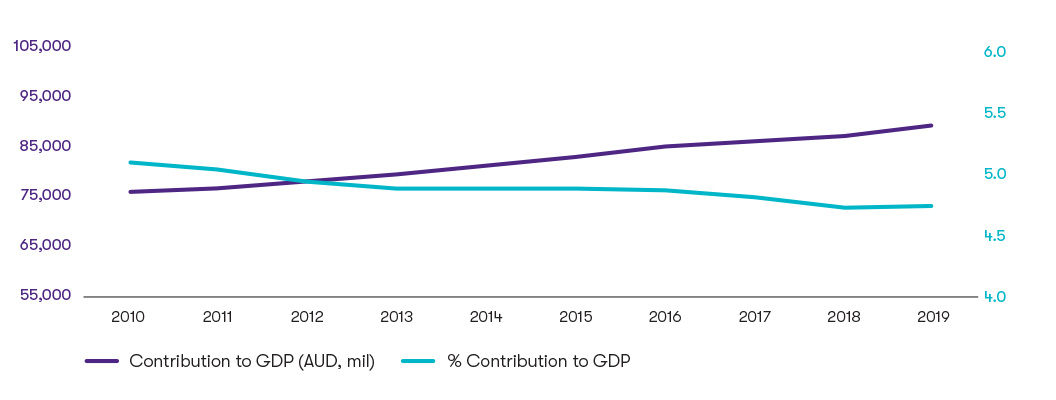
The education sector has experienced a tumultuous few years. Despite this the contribution of the sector in dollar value continues to trend steadily upwards, particularly as Australian universities continued to attract students from all over the world looking for a first rate education.
Then came COVID-19 and we lost nearly all of our access to international students overnight – and the impact this has on the entire funding model is immense – which in turn affects our research and development capacity, largely driven out of our universities.
‘Job-Ready Graduates’ reforms are currently under negotiation in Parliament, with negotiations for funding models on the cards. If we need job ready graduates to drive the economic recovery, we need adequate training, qualifications and resources to do so. Higher education played a part in the rebuilding of Australia’s economy after World War II. And it can do it again.![GTAL_2020_EDU_FB_Graph.jpg]()
Job creation must be supported by training and retraining
The Government has already picked six industry ‘winners’. In order to deliver on any of the promises and investment from the Budget, we’ll need a sufficiently educated and trained workforce. Money spent at universities and the VET sector goes straight back into the economy, and Australia. Regional Australia is one of the areas of the higher education sector that could use more investment. Youth in regional areas are half as likely to obtain a university qualification as those who live in the city. But regional universities are potentially at the forefront of where we need to be in terms of partnering with industry. Finally, there needs to be a review of our childcare sector. We know universal access to quality childcare improves participation in the workforce. We saw this in action during COVID.
In our report we cover:
- A decade of debt and reform
- Soft diplomacy
- Skilled workers to drive investment in priority industries
- R&D key to our economic recovery
- Skills training for the future
- Women’s participation in the workforce and childcare
- So where to from here?
![GTAL_2020_Federal-Budget-2020-21.jpg]()
Looking back to look forward
We were initially writing the ‘Federal Budget: A 10 year retrospective’ report before COVID-19 as an advocacy piece for more industry investment and support. Of course, the way the year started is not the way the year is ending. Many sectors that had been left to their own devices are now key for our recovery. Sovereign capability. Jobs. Digital economy. Modern manufacturing. Renewable future. Deregulation. Innovation. These are the terms we will use as we settle into COVID-normal.
Our report looks retrospectively at 13 different industries, the investment made into them by Government and their contribution to GDP. This is then overlaid with the opportunity we see for industry in this new normal based on recent Government announcements.
Download report